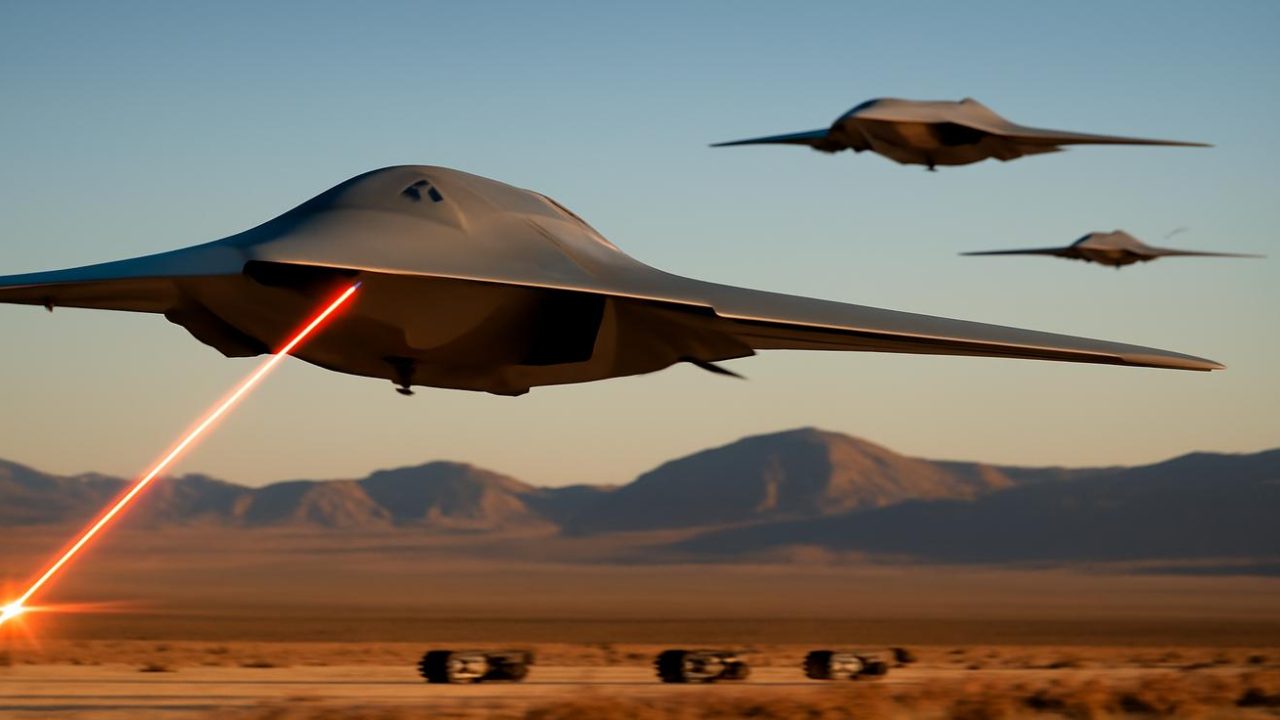
The battlefield of the future might look nothing like the wars of the past. Instead of thunderous explosions and roaring engines, imagine a pinpoint of light reaching across the desert sky, followed only by the faint smell of burned ozone and the silent disappearance of an enemy drone.
The United States military is developing what can only be described as a Star Wars-style defense system, using laser-equipped drones to counter the growing threat of kamikaze drones that are already reshaping modern warfare across the globe.
These aren’t science fiction fantasies anymore. Test ranges in Nevada are witnessing the quiet revolution of directed-energy weapons, where beams of light erase small aircraft from the sky without the dramatic explosions Hollywood has taught us to expect.

The Silent Threat Changing Modern Warfare
Kamikaze drones represent a fundamental shift in how wars are fought. These small unmanned aircraft, officially known as “loitering munitions,” operate with a patience that human pilots could never match.
Unlike traditional missiles that streak toward their targets in seconds, these drones can circle quietly for hours. They hug terrain, slip between buildings, and wait for the perfect moment to strike—when a tank starts its engine or a radar installation powers up.
The psychological impact is as devastating as the physical damage. Soldiers describe the experience as being stalked by a swarm of invisible hornets, each carrying a grenade and possessing unlimited patience.

From the trenches of Eastern Europe to remote outposts in the Middle East, these weapons have already proven their effectiveness. They’re cheap to produce, difficult to detect, and capable of overwhelming traditional air defense systems through sheer numbers.
America’s Laser-Armed Response
The U.S. military’s answer to this emerging threat combines two cutting-edge technologies: advanced drone platforms and directed-energy weapons systems.
The concept is elegant in its simplicity. American drones equipped with laser systems patrol the skies, scanning for incoming threats. When they detect a kamikaze drone, they engage with a beam of concentrated light that can disable or destroy the target without traditional ammunition.

This approach offers several critical advantages over conventional weapons:
- Unlimited “ammunition” as long as power systems function
- Precise targeting that minimizes collateral damage
- Silent operation that doesn’t reveal defensive positions
- Cost-effective engagement of low-value targets
- Ability to engage multiple threats rapidly
The laser systems operate at the speed of light, making them ideal for countering fast-moving or maneuvering targets. Unlike missiles or bullets, there’s no travel time to calculate, no trajectory to predict—just point and engage.
Key Technical Capabilities and Limitations
The effectiveness of laser weapons depends on several critical factors that military planners must consider when deploying these systems.

| Factor | Advantage | Limitation |
|---|---|---|
| Weather Conditions | Effective in clear conditions | Reduced effectiveness in fog, rain, or dust |
| Power Requirements | Sustainable with proper generators | High energy consumption per engagement |
| Range | Line-of-sight engagement | Limited by atmospheric conditions |
| Target Type | Excellent against drones and light aircraft | Less effective against hardened targets |
The drone platforms carrying these laser systems must balance power generation, flight endurance, and payload capacity. Engineers are working to optimize these competing demands while maintaining the mobility that makes drone-based systems attractive.
Heat management presents another significant challenge. Laser systems generate substantial thermal energy that must be dissipated to prevent damage to the weapon itself or the aircraft carrying it.
Real-World Impact on Military Strategy
The development of laser-armed drone swarms represents more than just a new weapon system—it signals a fundamental shift in military doctrine and battlefield tactics.

Traditional air defense relies on expensive missiles to engage threats, creating an economic imbalance where cheap attack drones can force the expenditure of costly defensive weapons. Laser systems potentially reverse this equation, allowing defenders to engage low-cost threats with equally low-cost responses.
This capability could reshape how military forces protect critical infrastructure, forward operating bases, and civilian areas. Instead of relying on static defensive positions, mobile laser-equipped drones could provide flexible, responsive protection that adapts to changing threat patterns.
The technology also has implications for naval operations, where ships face increasing threats from small, fast-moving attack craft and drone swarms. Laser systems could provide a crucial defensive layer without depleting limited missile inventories.

For ground forces, the promise of overhead protection from patient, circling defenders offers a psychological advantage that could prove as valuable as the physical protection itself.
The Path Forward for Directed-Energy Defense
While the basic technology has been demonstrated in test environments, significant challenges remain before laser-armed drone systems become standard military equipment.
Power systems need to become more efficient and lighter to extend operational endurance. Laser components must prove their reliability in harsh field conditions, from desert heat to arctic cold.

Integration with existing command and control systems will determine how effectively these weapons can coordinate with traditional forces. The ability to distinguish friend from foe becomes critical when engagement happens at the speed of light.
Training represents another crucial factor. Operators will need to understand the unique characteristics of directed-energy weapons, from their environmental limitations to their engagement protocols.
The military is also exploring how these systems might work in coordinated swarms, where multiple laser-equipped drones could provide overlapping defensive coverage or concentrate fire on hardened targets.

Frequently Asked Questions
How do laser weapons actually destroy drones?
The concentrated energy beam heats critical components or fuel systems until they fail, causing the drone to crash or explode.
Can these laser systems work in bad weather?
Weather significantly affects laser performance, with fog, rain, and dust reducing effectiveness compared to clear conditions.
How much does it cost to fire a laser weapon?
The primary cost is electrical power, making each shot potentially much cheaper than traditional missiles or ammunition.
When will these systems be deployed?
The timeline for full deployment has not been publicly confirmed, as testing continues in controlled environments.
Can laser weapons engage multiple targets simultaneously?
Current systems typically engage one target at a time, but multiple drones could coordinate to provide broader coverage.
What happens if the laser system’s power fails?
The specific backup systems and redundancies have not been detailed in available information about these developing programs.











Leave a Comment