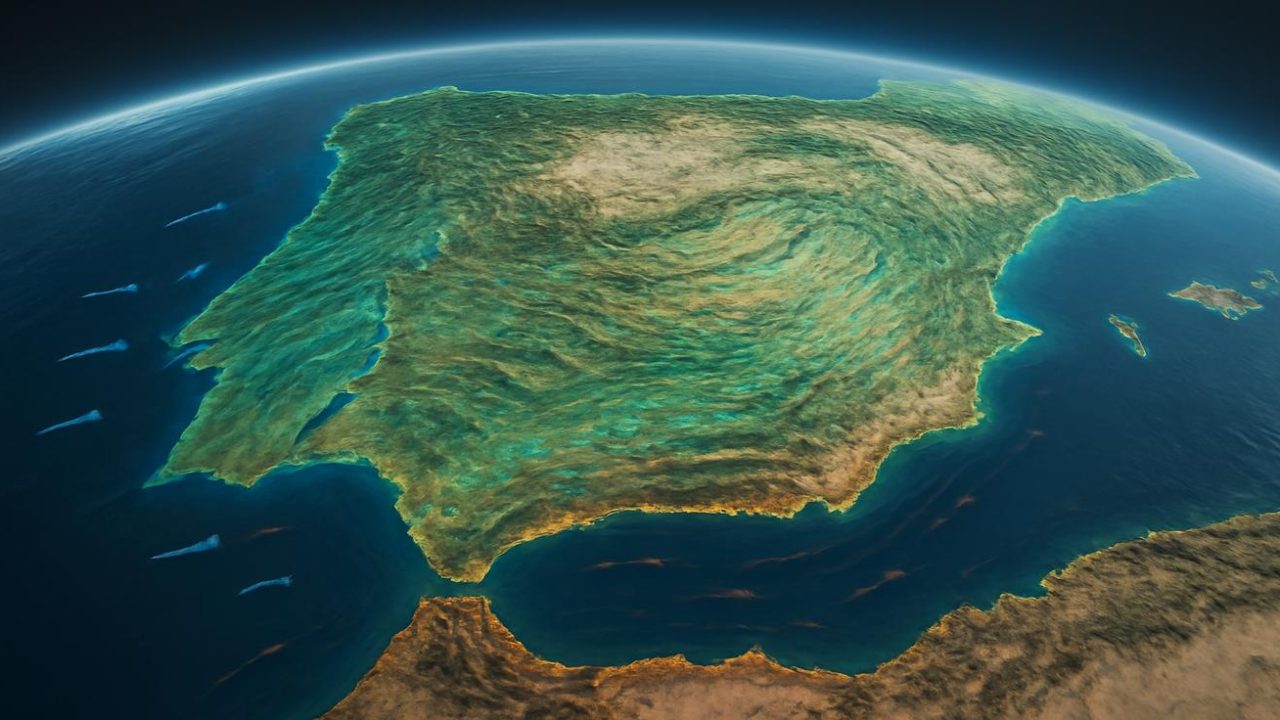
High-precision GPS receivers scattered across Spain and Portugal have detected something extraordinary: the entire Iberian Peninsula is slowly rotating in place, turning millimeter by millimeter like a massive geological key in an invisible lock.
The discovery emerged not from dramatic earthquakes or visible cracks in the earth, but from years of patient data collection. GPS stations fixed to granite outcrops and concrete pillars from Galicia to the Algarve have been quietly tracking tiny movements across the peninsula, measuring shifts so small they would require a microscope to detect in human terms.
When scientists finally analyzed the accumulated data, they found something unexpected. Rather than moving in straight lines like typical continental drift, the measurement points revealed a rotational pattern—as if Spain and Portugal were performing a slow, synchronized dance on the Earth’s surface.

How Scientists Discovered the Continental Rotation
The revelation came through meticulous analysis of GPS data collected over multiple years. Each receiver had been measuring its position relative to satellites with extraordinary precision, tracking movements measured in millimeters.
What made the discovery remarkable was how the tiny vectors of movement aligned across the peninsula. Instead of uniform directional movement, some points nudged northward, others slightly south, and some fractionally west. But when mapped together, these movements created a clear rotational pattern.
The GPS network essentially revealed that Iberia wasn’t simply drifting—it was turning. The data showed the peninsula rotating around a specific point, though the movement occurs at geological timescales imperceptible to human observation.

This type of continental rotation is rare in geological terms. Most tectonic movements involve plates sliding past each other or colliding head-on. The discovery that an entire peninsula could be rotating in place represents a unique form of geological behavior.
The Science Behind Iberian Peninsula Movement
The rotation occurs deep beneath the surface, driven by forces within the Earth’s crust and upper mantle. While people going about their daily lives—boarding ferries in Lisbon harbor or walking through Spanish cities—feel nothing, the bedrock beneath them participates in this slow geological waltz.
The movement happens at scales that make it invisible to human perception. Coffee cups don’t rattle, ship captains don’t need to adjust their courses, and buildings remain perfectly stable. Yet the very foundation of the peninsula continues its patient rotation.

Understanding this movement requires thinking in geological time. What appears stationary and permanent from a human perspective operates on timescales spanning thousands or millions of years. The GPS data captures just a snapshot of this much longer process.
The forces driving this rotation likely stem from the complex interaction between the African and Eurasian tectonic plates. As these massive plates continue their own movements, they create stresses and pressures that manifest in unexpected ways—including the rotation of entire peninsulas.
Why This Discovery Matters for Understanding Earth’s Dynamics
The detection of Iberian rotation provides scientists with new insights into how continents can move. Traditional models of plate tectonics focus primarily on linear movements—plates sliding, separating, or colliding. Rotational movement adds another dimension to understanding continental dynamics.
This discovery also demonstrates the power of modern measurement technology. The GPS network’s ability to detect millimeter-scale movements across vast distances represents a revolution in geological monitoring. Such precision allows scientists to observe processes that were previously theoretical.
For researchers studying earthquake risks and geological hazards, understanding rotational movement patterns could provide new predictive capabilities. If continents can rotate, this movement might influence stress patterns that contribute to seismic activity.
The finding also raises questions about other continental masses. If the Iberian Peninsula rotates, scientists wonder whether similar movements might be occurring elsewhere, previously undetected due to insufficient monitoring networks.

The Divided Scientific Response
The discovery has created a fascinating split in scientific and public opinion. Some researchers express alarm at the implications of continental rotation, viewing it as evidence of potentially significant geological instability or change.
Others maintain a position of scientific indifference, arguing that such slow movements represent normal geological processes operating within expected parameters. They contend that rotation at millimeter scales over extended timeframes falls well within the range of natural continental behavior.
This division reflects broader questions about how to interpret geological data. When movements occur at scales far removed from human experience, determining their significance becomes a matter of scientific judgment and interpretation.

The debate also highlights the challenge of communicating geological discoveries to the public. Movements measured in millimeters over years can seem either insignificant or alarming, depending on one’s perspective and understanding of geological processes.
What Continued Monitoring Will Reveal
Scientists plan to continue tracking the peninsula’s movement through the existing GPS network. Long-term monitoring will help determine whether the rotation rate remains constant or changes over time.
Future observations will also help researchers understand the relationship between this rotation and other geological processes in the region. Connecting the movement to seismic activity, volcanic processes, or broader tectonic patterns could provide valuable insights.

The data collection will likely expand to include more measurement points and potentially other monitoring technologies. As detection methods improve, scientists may discover additional subtle movements previously beyond their observational capabilities.
Understanding the rotation’s long-term implications will require decades of continued observation. Only through extended monitoring can researchers determine whether this represents a temporary geological phase or a persistent characteristic of the Iberian Peninsula.
Frequently Asked Questions
Can people feel the Iberian Peninsula rotating?
No, the rotation occurs at such a slow rate—measured in millimeters over years—that it’s completely imperceptible to human senses.

How did scientists discover this rotation?
Through high-precision GPS receivers placed across Spain and Portugal that tracked tiny movements over multiple years, revealing a rotational pattern when the data was analyzed.
Is this continental rotation dangerous?
The scientific community is divided, with some expressing concern while others view it as normal geological activity within expected parameters.
How fast is the peninsula rotating?
The movement occurs at millimeter scales over extended timeframes, making it extremely slow by human standards but detectable by precise GPS measurements.
Are other continents also rotating?
This hasn’t been confirmed, though the discovery raises questions about whether similar movements might be occurring elsewhere with sufficient monitoring networks.
Will this affect daily life in Spain and Portugal?
Current evidence suggests the movement is too slow and subtle to impact daily activities, infrastructure, or human perception in any noticeable way.










Leave a Comment