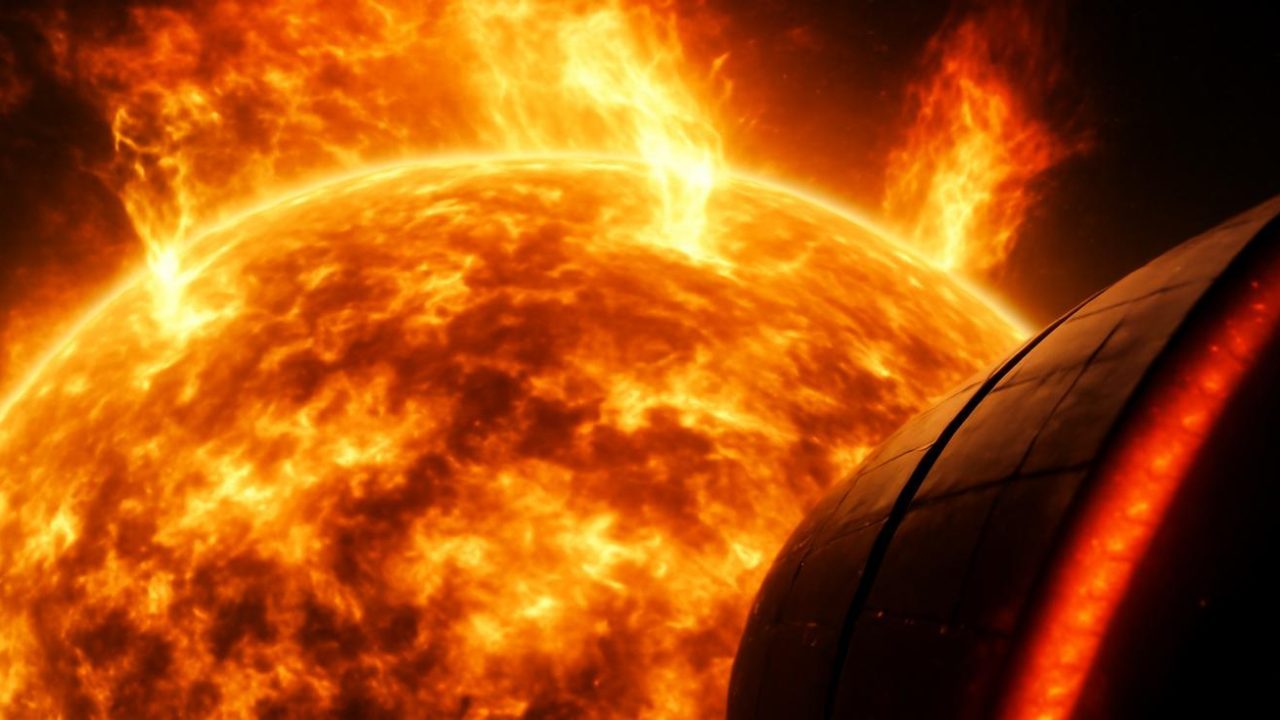
Dr. Elena Vasquez had been studying the Sun for twenty-three years, but nothing prepared her for the moment she opened the data files from humanity’s closest solar encounter. Her hands trembled slightly as she scrolled through readings that defied everything textbooks had taught her about our nearest star.
“This changes everything we thought we knew,” she whispered to her colleague, staring at temperature readings that seemed impossible. The Parker Solar Probe had just completed its record-breaking flyby, coming within 3.8 million miles of the Sun’s surface—seven times closer than any previous mission.
What the probe discovered during those crucial hours is now rewriting one of astronomy’s most enduring puzzles, a mystery that has stumped scientists for over a century.

The Solar Mystery That Refused to Make Sense
For more than 100 years, scientists have been scratching their heads over a fundamental question about our Sun: why is its outer atmosphere, called the corona, hundreds of times hotter than its surface?
Think about it this way—it’s like discovering that the air around a campfire is somehow much hotter than the flames themselves. The Sun’s surface burns at about 10,000 degrees Fahrenheit, but the corona reaches temperatures of over 2 million degrees. This violates our basic understanding of how heat should work.
The Parker Solar Probe, launched in 2018, was specifically designed to solve this puzzle. Named after Eugene Parker, the physicist who first theorized about solar wind, this car-sized spacecraft has been gradually spiraling closer to the Sun with each orbit.

We’ve been trying to understand coronal heating for decades. Parker’s data is giving us the first real answers to questions we’ve been asking since the early 1900s.
— Dr. Nour Raouafi, Parker Solar Probe Project Scientist
The probe’s latest close approach in December 2024 brought it closer to our star than ever before, surviving temperatures of 1,800 degrees Fahrenheit while protected by a revolutionary heat shield made of carbon composite materials.
What Parker Found Will Blow Your Mind
The data streaming back from Parker’s instruments is revealing secrets hidden in the Sun’s corona for eons. Here’s what scientists have discovered:

| Discovery | What It Means |
|---|---|
| Magnetic field reversals | Sudden flips in magnetic direction that release massive energy |
| Plasma jets | High-speed streams of charged particles shooting outward |
| Wave interactions | Complex energy transfers that heat the corona |
| Dust-free zones | Areas where solar energy has vaporized all nearby particles |
The most groundbreaking finding involves something called “switchbacks”—sudden reversals in the Sun’s magnetic field that occur like cosmic whips cracking in space. These switchbacks appear to be one of the primary mechanisms heating the corona to those extreme temperatures.
- Magnetic field lines twist and snap like rubber bands
- Each snap releases enormous amounts of energy
- This energy heats surrounding plasma to millions of degrees
- The heated plasma then expands outward as solar wind
It’s like watching the Sun’s magnetic field have a temper tantrum. These switchbacks are far more violent and frequent than we ever imagined.
— Dr. Stuart Bale, University of California Berkeley
Parker has also detected what scientists call “rogue waves” in the solar wind—massive disturbances that can be ten times larger than surrounding waves. These cosmic tsunamis carry incredible amounts of energy and may play a crucial role in accelerating particles to incredible speeds.

Why This Matters for Life on Earth
You might wonder why solving a century-old solar mystery affects your daily life. The answer lies in something called space weather, and it impacts far more than you might realize.
The same processes that heat the Sun’s corona also drive solar storms that can wreak havoc on Earth. When the Sun releases massive bursts of energy called coronal mass ejections, they can travel the 93 million miles to Earth in just a few days.
These solar storms can:

- Knock out power grids, leaving millions without electricity
- Disrupt GPS systems that we rely on for navigation
- Interfere with satellite communications
- Force airlines to reroute flights to avoid radiation
- Damage expensive spacecraft and instruments
Understanding how the corona works gives us better tools to predict when these storms might hit Earth. It’s like having a better weather forecast, but for space.
Every new piece of data from Parker helps us build better models for space weather prediction. This isn’t just academic curiosity—it’s about protecting our technology-dependent society.
— Dr. Nicholeen Viall, NASA Goddard Space Flight Center
The economic impact of severe space weather events can reach into the trillions of dollars. The infamous 1989 geomagnetic storm knocked out power for 6 million people in Quebec for nine hours. A similar event today could be far more devastating given our increased reliance on electronic systems.

The Road Ahead for Solar Science
Parker’s mission isn’t over yet. The probe will continue making closer approaches to the Sun through 2025, with each flyby potentially revealing new secrets about our star.
Scientists are particularly excited about upcoming observations that will occur during solar maximum—the peak of the Sun’s 11-year activity cycle. During this period, solar storms and magnetic activity reach their highest levels, giving Parker a front-row seat to the Sun’s most dramatic behavior.
We’re essentially getting a complete physical exam of our Sun for the first time. Every measurement brings us closer to solving puzzles that have existed since before my great-grandfather was born.
— Dr. Adam Szabo, NASA Mission Scientist

The data from Parker is also helping scientists better understand other stars throughout the universe. Since we can’t send probes to distant stars, understanding our Sun in detail helps us interpret observations of stellar activity across the galaxy.
Future missions are already being planned to build on Parker’s discoveries. The European Space Agency’s Solar Orbiter mission is providing complementary observations, while ground-based solar telescopes are capturing unprecedented images of the Sun’s surface activity.
As we continue to unravel the mysteries of our nearest star, one thing becomes clear: the Sun still has plenty of surprises left to share. Each discovery not only satisfies our curiosity about the cosmos but also helps us better prepare for the ways our star continues to influence life on Earth.

FAQs
How close did the Parker Solar Probe get to the Sun?
The probe flew within 3.8 million miles of the Sun’s surface, which is about seven times closer than any previous spacecraft.
How hot did the spacecraft get during its closest approach?
The heat shield reached temperatures of about 1,800 degrees Fahrenheit, while the instruments inside stayed at room temperature.
What is the corona heating problem?
It’s the mystery of why the Sun’s outer atmosphere is hundreds of times hotter than its surface, which seems to violate basic physics.
How do solar storms affect Earth?
They can disrupt power grids, GPS systems, satellite communications, and force airlines to reroute flights to avoid radiation.
When will Parker’s mission end?
The mission will continue through 2025, with the probe making even closer approaches to the Sun during that time.
What are switchbacks in the solar wind?
They’re sudden reversals in the Sun’s magnetic field that release massive amounts of energy and help heat the corona to extreme temperatures.











Leave a Comment