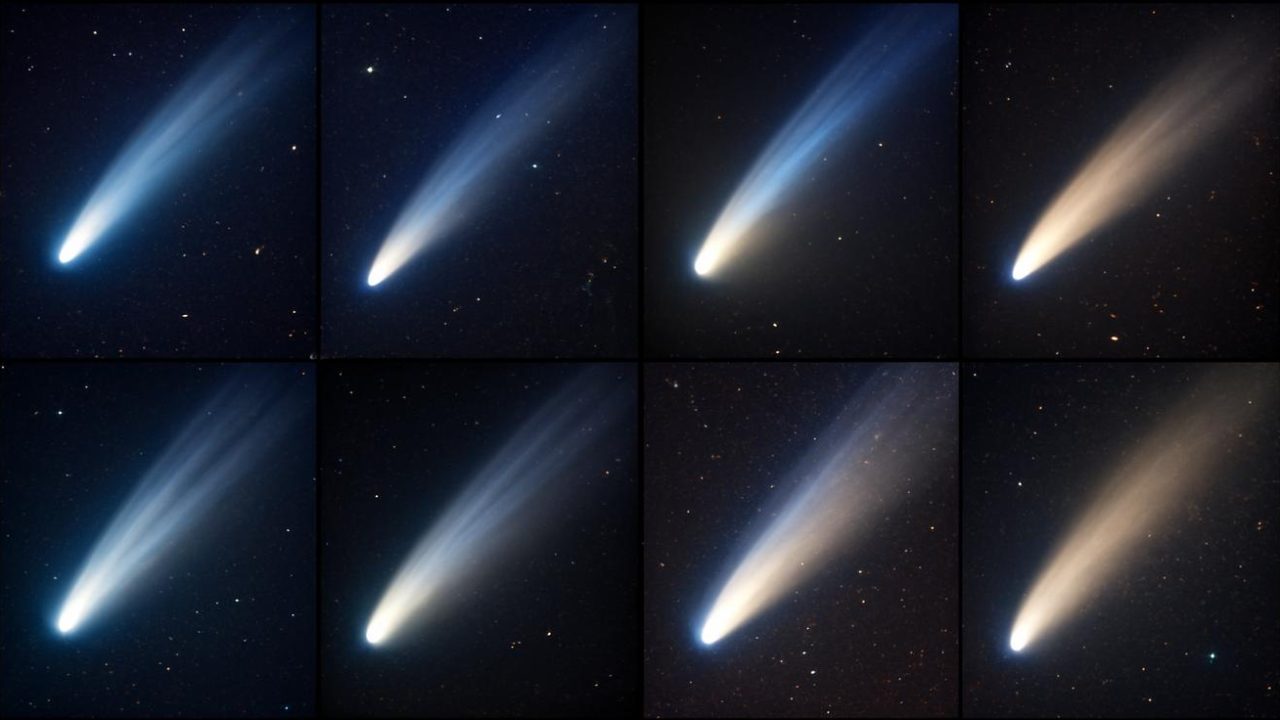
A tiny, pale blur captured in eight new spacecraft images represents something extraordinary: humanity’s third confirmed visitor from another star system. The interstellar comet 3I ATLAS appears as little more than a soft streak against the cosmic darkness, but these unprecedented photographs reveal an object that doesn’t belong to our solar system at all.
Unlike the comets that have captivated humans for centuries, 3I ATLAS will never return. It’s passing through our neighborhood on a one-way journey back to the vast emptiness between stars, offering scientists a rare glimpse of material forged in an alien solar system.
The images show what researchers describe as a “grainy spray of stars” surrounding the polished black of interplanetary space, with the comet appearing as barely more than a thumbprint-sized glow on screen. Yet this unremarkable appearance masks one of astronomy’s most significant discoveries.

What Makes 3I ATLAS Different From Every Other Comet
For centuries, comets served as the sky’s most dramatic performers. They arrived with sweeping tails, inspired talk of omens, and returned on predictable schedules that astronomers could map decades in advance. But these cosmic showmen were all homegrown—icy bodies that formed in the outer reaches of our solar system and remained gravitationally bound to the Sun.
That familiar pattern changed forever in 2017 with the discovery of ‘Oumuamua, a strange, cigar-shaped object that clearly originated beyond our solar system. Two years later, astronomers identified 2I/Borisov, the first obviously comet-like visitor from interstellar space.
3I ATLAS represents the third member of this exclusive club. Unlike our local comets that loop back toward the Sun in elliptical orbits, these interstellar wanderers follow hyperbolic trajectories that carry them straight through our solar system and back into the cosmic void.

The discovery opens what researchers describe as a new chapter in astronomy. Instead of studying only the leftover materials from our own solar system’s formation, scientists can now examine what they call “crumbs flung from other planetary kitchens.”
The Challenge of Capturing Visitors From Deep Space
Photographing an interstellar comet requires exceptional timing and precision. These objects spend most of their existence in the frigid darkness between star systems, becoming visible only during their brief passage through the inner solar system where sunlight can illuminate their surfaces and activate their icy components.
By the time most people learn about these discoveries, the objects are already departing. 3I ATLAS is currently sliding back toward the deep black between stars, following the same pattern as its predecessors.

The eight new spacecraft images represent a significant technical achievement. Capturing clear photographs of such distant, fast-moving objects requires sophisticated tracking systems and precise calculations to predict their exact position against the star field.
| Interstellar Object | Discovery Year | Classification | Current Status |
|---|---|---|---|
| ‘Oumuamua | 2017 | Asteroid-like | Departed solar system |
| 2I/Borisov | 2019 | Comet-like | Departed solar system |
| 3I ATLAS | Recent | Comet | Departing solar system |
What These Images Reveal About Alien Solar Systems
Each interstellar visitor carries invaluable information about conditions in distant solar systems. The composition, structure, and behavior of these objects provide clues about how planets and comets form around other stars.
The clarity achieved in the 3I ATLAS images allows scientists to study details that were impossible to observe in previous interstellar objects. While the comet appears as a simple blur to casual observers, researchers can extract data about its size, rotation, composition, and the way it responds to solar heating.

These measurements help answer fundamental questions about whether the building blocks of solar systems are similar across the galaxy. Do other star systems produce comets with the same mix of ice and rock found in our own cosmic backyard? Or do different stellar environments create entirely different types of objects?
The fact that astronomers have now identified three interstellar objects in less than a decade suggests these visitors may be more common than previously thought. Improved detection methods and more sensitive telescopes are revealing a steady stream of cosmic wanderers that have been passing through unnoticed for millennia.
Why Timing Matters for Interstellar Object Research
The window for studying interstellar visitors is frustratingly brief. These objects spend millions of years crossing the emptiness between stars, but remain within telescopic range for only months or years during their passage through our solar system.

Scientists must mobilize quickly once a new interstellar object is detected. Observation schedules must be rearranged, spacecraft instruments redirected, and research teams assembled—all while the target is already speeding away from the Sun.
The eight spacecraft images of 3I ATLAS represent the culmination of this rapid-response effort. Multiple space-based telescopes likely coordinated their observations to capture the comet from different angles and at different wavelengths of light.
This collaborative approach maximizes the scientific return from each rare encounter. Ground-based telescopes face limitations from atmospheric interference and weather conditions, making space-based observations particularly valuable for studying faint, distant objects.

What Happens Next in Interstellar Object Hunting
The success in capturing detailed images of 3I ATLAS demonstrates that astronomical technology has advanced to the point where interstellar visitors can be studied in unprecedented detail. Future discoveries will likely yield even more information as detection methods continue to improve.
Several next-generation telescopes currently under development will dramatically expand humanity’s ability to spot and track interstellar objects. These instruments will detect smaller, more distant visitors and provide earlier warnings that allow for more extensive observation campaigns.
The pattern established by ‘Oumuamua, 2I/Borisov, and now 3I ATLAS suggests that interstellar objects may visit our solar system regularly. Each new discovery adds another piece to the puzzle of how common Earth-like planets and solar systems might be throughout the galaxy.

As these cosmic visitors continue their journeys back into interstellar space, they carry with them the energy and particles they absorbed during their brief encounter with our Sun. In a sense, they become ambassadors carrying a small piece of our solar system to whatever distant destinations await them in the galaxy’s far reaches.
Frequently Asked Questions
What is 3I ATLAS?
3I ATLAS is an interstellar comet that originated from outside our solar system and is currently passing through on a one-way journey back to deep space.
How many interstellar objects have been discovered?
Three confirmed interstellar objects have been identified: ‘Oumuamua in 2017, 2I/Borisov in 2019, and now 3I ATLAS.

Will 3I ATLAS ever return to our solar system?
No, interstellar objects follow hyperbolic trajectories that carry them straight through our solar system without returning, unlike regular comets that orbit the Sun.
Why are these spacecraft images significant?
The eight new images provide unprecedented clarity for studying an interstellar visitor, allowing scientists to analyze details about its composition and behavior that reveal information about distant solar systems.
How do scientists detect interstellar objects?
Astronomers identify interstellar objects by tracking their trajectories and determining that they follow hyperbolic paths indicating they originated from outside our solar system.
What makes interstellar comets different from regular comets?
Regular comets formed in our solar system and remain gravitationally bound to the Sun, while interstellar comets originated around other stars and are just passing through our neighborhood.











Leave a Comment