For more than a decade, China has transformed empty ocean into solid ground, creating artificial islands in the South China Sea by dumping millions of cubic meters of sand and sediment onto submerged reefs. What appears as little gray-white smudges on satellite maps represents one of the most ambitious engineering projects of the modern era.
These aren’t natural formations shaped by coral growth or volcanic activity. Instead, they’re the product of massive dredging operations that have literally manufactured land where only water existed before.
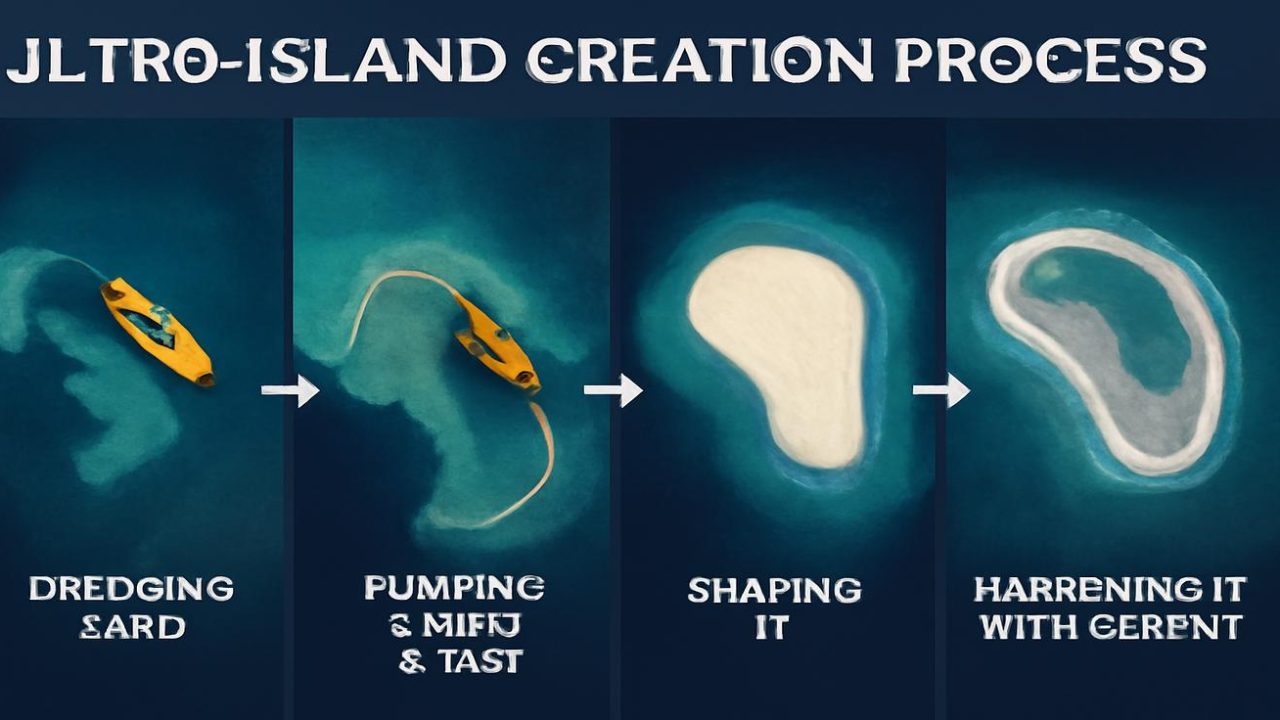
The scale of this undertaking becomes clear when you understand the machinery involved: enormous cutter-suction and trailing suction hopper dredgers working around the clock, scooping sediment from the seafloor and blasting it onto carefully plotted coordinates.

How China Builds Islands from Scratch
The process begins before dawn with the deep mechanical shudder of dredging equipment cutting through ship hulls. Steel arms unfold as these industrial vessels position themselves over shallow reefs and submerged shoals.
What follows is a relentless rhythm of extraction and deposition. Dredgers pull sand, crushed coral, mud, and water from the seafloor, creating massive plumes of sediment beneath their hulls. This material is then hurled skyward in industrial geysers, landing with precision on GPS-plotted locations.
The sound is described as artificial surf—a constant roar as millions of cubic meters of material are moved grain by grain, dredger by dredger. This process continues for months or years until enough sediment accumulates to raise submerged reefs above the waterline.

Once the basic land mass is established, the raw sediment is sculpted and hardened into permanent islands. Runways, geometric buildings, and other infrastructure follow, transforming what was once open ocean into functional military and civilian facilities.
The Environmental Cost of Island Building
The areas targeted for China’s island-building projects weren’t empty underwater deserts. These locations were vibrant coral reef ecosystems teeming with marine life.
Before dredging operations began, reefs like Fiery Cross and Mischief featured intricate coral formations in colors ranging from rust to bone to bruise-purple. Schools of fusiliers and damsel fish darted between branching corals, while parrotfish scraped algae with sounds audible through snorkeling equipment.

The transformation is devastating for marine ecosystems. When steel teeth descend into these underwater worlds, centuries of coral growth can be shattered in seconds. Sediment clouds block sunlight that coral polyps need to survive, while the fine particles choke fish gills and smother sea life.
Scientists refer to this underwater storm as turbidity—water thick with particles that blocks light and suffocates marine organisms. Unlike natural storms, this turbidity doesn’t end until the dredging operation is complete.
| Environmental Impact | Description |
|---|---|
| Coral Destruction | Centuries-old coral formations shattered during dredging |
| Turbidity | Sediment clouds block sunlight needed for marine life |
| Habitat Loss | Complete elimination of reef ecosystems |
| Species Displacement | Fish, turtles, and other marine life forced to relocate |
The Scale and Speed of Artificial Island Creation
What makes China’s island-building program remarkable isn’t just the engineering involved, but the compressed timeline. Natural processes that typically take millennia have been condensed into a decade of intensive construction.
The transformation is visible from space. Satellite imagery shows the progression from submerged reefs to fully functional islands complete with military installations, airstrips, and support facilities.
This represents civilization stepping into the role of geological force, collapsing what would normally be centuries of gradual land formation into years of mechanical construction. The technology itself isn’t particularly advanced—it’s heavy machinery, diesel engines, and steel equipment grinding through living reef.
Yet the outcome feels almost mythic in scope. Humans are manufacturing land in one of the most contested maritime regions on Earth, redrawing maps not with ink but with millions of tons of seafloor sediment.

Strategic Implications of Man-Made Islands
These artificial islands aren’t just engineering marvels—they’re strategic assets that extend China’s territorial claims and military reach in the South China Sea. By creating permanent land features where none existed before, China has established new facts on the water.
The islands serve multiple purposes beyond their symbolic value. They provide platforms for military equipment, radar installations, and aircraft operations in areas previously accessible only by ship.
The geometric precision of the buildings and infrastructure visible in satellite imagery suggests these facilities are designed for long-term strategic use rather than temporary occupation.

From a legal perspective, the creation of artificial islands raises complex questions about territorial waters, exclusive economic zones, and navigation rights in international waters.
What Happens Next in the South China Sea
The island-building program represents a new chapter in how nations might assert territorial claims and project power in maritime regions. The success of China’s dredging operations demonstrates that modern technology can rapidly alter geographic realities.
The environmental consequences will likely persist for decades. Destroyed coral reefs take centuries to regenerate naturally, and some damage may be permanent. The marine ecosystems that once thrived in these areas face an uncertain future.

Meanwhile, the strategic implications continue to evolve as these artificial islands become integrated into broader military and civilian infrastructure networks. What began as empty ocean has become a permanent part of the region’s political and military landscape.
The technology and techniques developed during this massive undertaking could potentially be applied to other disputed maritime areas, suggesting that artificial island creation might become a more common geopolitical tool.
Frequently Asked Questions
How long did it take China to build these artificial islands?
The island-building program has been ongoing for more than a decade, with intensive dredging operations beginning in the early 2010s.

What materials are used to create the artificial islands?
The islands are built using sand, crushed coral, mud, and sediment extracted from the seafloor by specialized dredging vessels.
Were these areas completely empty before the island building began?
No, these locations featured vibrant coral reef ecosystems with diverse marine life before dredging operations destroyed the natural habitats.
How many artificial islands has China created?
The source material describes multiple islands including Fiery Cross and Mischief, but doesn’t provide a specific total number of completed artificial islands.
Can the environmental damage be reversed?
Coral reefs typically take centuries to develop naturally, making the environmental damage largely permanent within human timescales.
What equipment is used for the dredging operations?
China uses enormous cutter-suction and trailing suction hopper dredgers capable of moving millions of cubic meters of seafloor material.










Leave a Comment