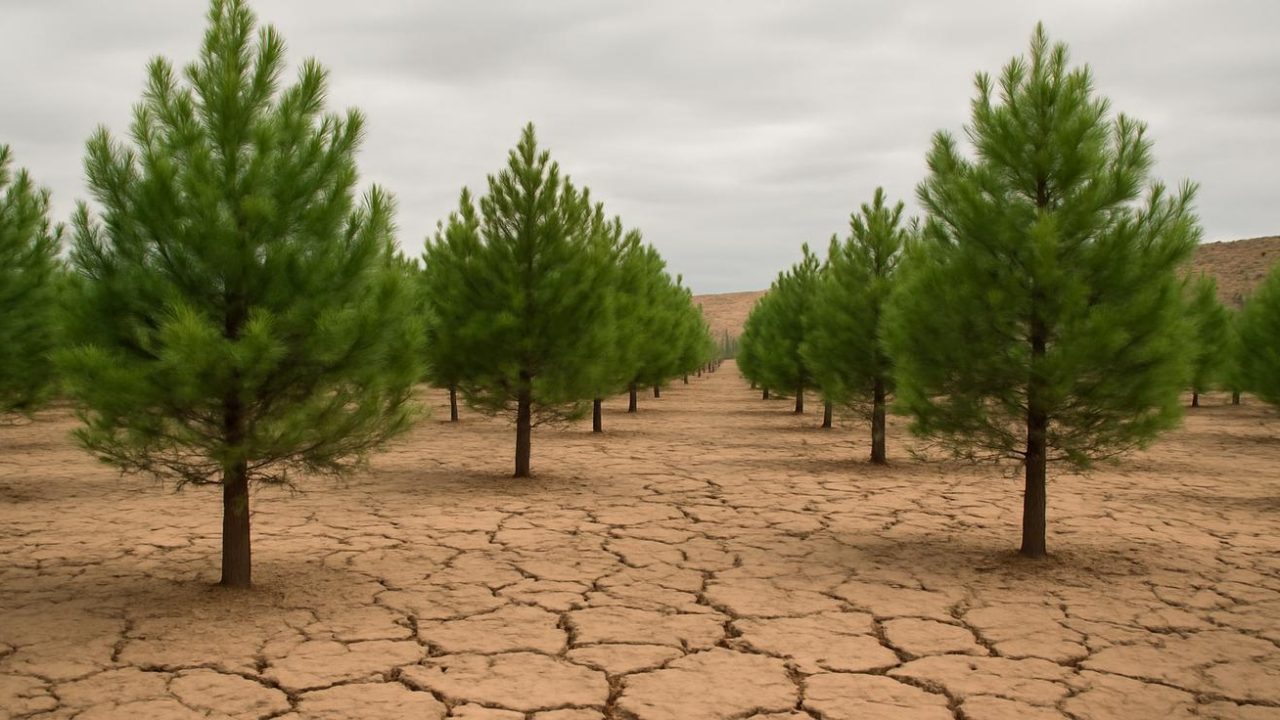
China has been planting billions of trees across its northern regions for more than four decades in an ambitious effort to stop desert expansion, but the massive reforestation project is raising unexpected concerns about its impact on delicate ecosystems.
The Great Green Wall, as the project is known, stretches across China’s arid north where farmers once watched clear blue skies give way to dusty horizons and rivers that now carry the color of sand. What began as a bold plan to redraw the country’s map has created thin green lines of saplings marching into sand dunes, with trees standing like soldiers trying to hold back the desert.
From satellite images, the transformation appears heroic—yellow and tan desert slowly bordered by new patches of green. On the ground, the reality reveals regimented armies of poplars, willows, and pines standing in ruler-straight lines, their trunks wrapped in sun-faded plastic guards and connected by irrigation tubes snaking between them like black veins.

How China’s Billion-Tree Project Works
The Great Green Wall represents one of the world’s most ambitious environmental engineering projects. The initiative targets the advancing Gobi Desert, which has been creeping steadily into farmland, cities, and populated areas.
The scale of the undertaking becomes clear when traveling through Inner Mongolia, where buses pass landscapes that shift dramatically from bare sand to carefully planted forests. These aren’t natural woodlands—they’re precisely planned installations designed to create barriers against desert expansion.
The project focuses on strategic tree placement across China’s arid northern regions. Each planting site receives irrigation infrastructure and protective materials to help saplings survive in harsh desert conditions. The trees are selected for their ability to withstand dry climates and sandy soil.

Local communities have witnessed dramatic changes. Farmers who remember springs with grass pushing through fertile soil now see structured tree lines replacing the advancing sand. The air itself feels different in these areas, though dust and wind remain constant challenges.
Environmental Concerns Scientists Are Raising
While the tree-planting initiative shows visible progress in slowing desert expansion, researchers are identifying potential problems with the approach. The concerns center on how massive monoculture plantations might affect fragile ecosystems that have adapted to arid conditions over thousands of years.
The regimented nature of the plantings creates artificial environments that differ significantly from natural desert ecosystems. Scientists worry about several key impacts:

- Disruption of natural water cycles in already water-scarce regions
- Potential harm to native plant and animal species adapted to desert conditions
- Soil composition changes that could affect long-term ecosystem stability
- Unintended consequences of introducing non-native tree species to desert environments
The irrigation systems required to sustain the trees draw water from sources that desert wildlife and plants depend on. This competition for scarce water resources could create new environmental pressures in regions already struggling with drought.
The Reality of Desert Transformation
Visitors to the project areas witness a landscape in transition. The contrast between natural desert and planted forest zones creates stark visual boundaries that don’t exist in nature. These artificial borders represent both the project’s ambitions and its potential ecological risks.
The planted trees require ongoing maintenance and protection that natural desert vegetation doesn’t need. Plastic guards protect young trunks from sandstorms and extreme temperatures, while irrigation networks provide water that would never naturally reach these areas.

| Project Aspect | Observable Impact | Scientific Concern |
|---|---|---|
| Tree Survival | Requires intensive irrigation and protection | Unsustainable water usage in arid regions |
| Planting Pattern | Ruler-straight lines of identical species | Lack of biodiversity compared to natural systems |
| Desert Boundary | Visible barriers between sand and forest | Disruption of natural ecosystem transitions |
The maintenance requirements raise questions about the project’s long-term sustainability. Natural desert ecosystems function without human intervention, while these planted forests depend on continued water supplies and care to survive.
What This Means for Desert Communities
For people living in affected areas, the Great Green Wall represents both hope and uncertainty. Communities that have watched farmland disappear under advancing sand see the tree barriers as protection for their livelihoods and homes.
The project has changed daily life in desert-edge communities. Where residents once faced unobstructed sandstorms and dust clouds, they now see green barriers attempting to block the wind. The visual transformation affects everything from air quality to local weather patterns.
However, the ecological concerns raised by scientists could have long-term implications for these same communities. If the artificial forests prove unsustainable or damage natural water sources, the environmental consequences could be severe.
Local farmers and herders who depend on natural desert resources for their livestock and traditional practices may find their way of life affected by the changing landscape. The shift from natural desert to managed forest alters the entire ecosystem these communities have adapted to over generations.
The Ongoing Debate About Desert Management
The Great Green Wall illustrates the complex challenges of large-scale environmental intervention. While the immediate goal of stopping desert expansion appears to be working in some areas, the broader ecological implications remain unclear.

The project continues expanding despite scientific concerns, with new plantings adding to the existing forest barriers. Each planting season brings more saplings, irrigation lines, and protective equipment to previously untouched desert areas.
The tension between immediate human needs and long-term ecological health defines this ongoing environmental experiment. Communities want protection from advancing sand, but scientists warn that the solution might create new problems for desert ecosystems.
The scale of the project means that any negative consequences could affect vast areas of China’s northern regions. Once established, these artificial forests would be difficult to remove if they prove harmful to natural systems.

The debate reflects broader questions about how humans should respond to environmental challenges. The Great Green Wall represents an engineering approach to desert management, but critics argue for solutions that work with natural systems rather than against them.
Frequently Asked Questions
How long has China been working on the Great Green Wall project?
The project has been ongoing for more than four decades, representing one of the world’s longest-running reforestation efforts.
What types of trees are being planted in the desert regions?
The project uses poplars, willows, and pines that are selected for their ability to survive in arid conditions with irrigation support.

Is the tree-planting project actually stopping desert expansion?
The project appears to be slowing desert expansion in targeted areas, creating visible barriers between sand and planted forest zones.
What are scientists most concerned about regarding the project?
Researchers worry about potential damage to fragile desert ecosystems, disruption of natural water cycles, and the sustainability of maintaining artificial forests in arid regions.
How do the planted forests differ from natural desert vegetation?
The planted trees grow in ruler-straight lines and require intensive irrigation and protection, unlike natural desert plants that adapt to harsh conditions without human intervention.
What happens to communities living in areas where trees are being planted?
Local communities experience changes in air quality, weather patterns, and landscape, though the long-term effects on their traditional way of life remain unclear.










Leave a Comment