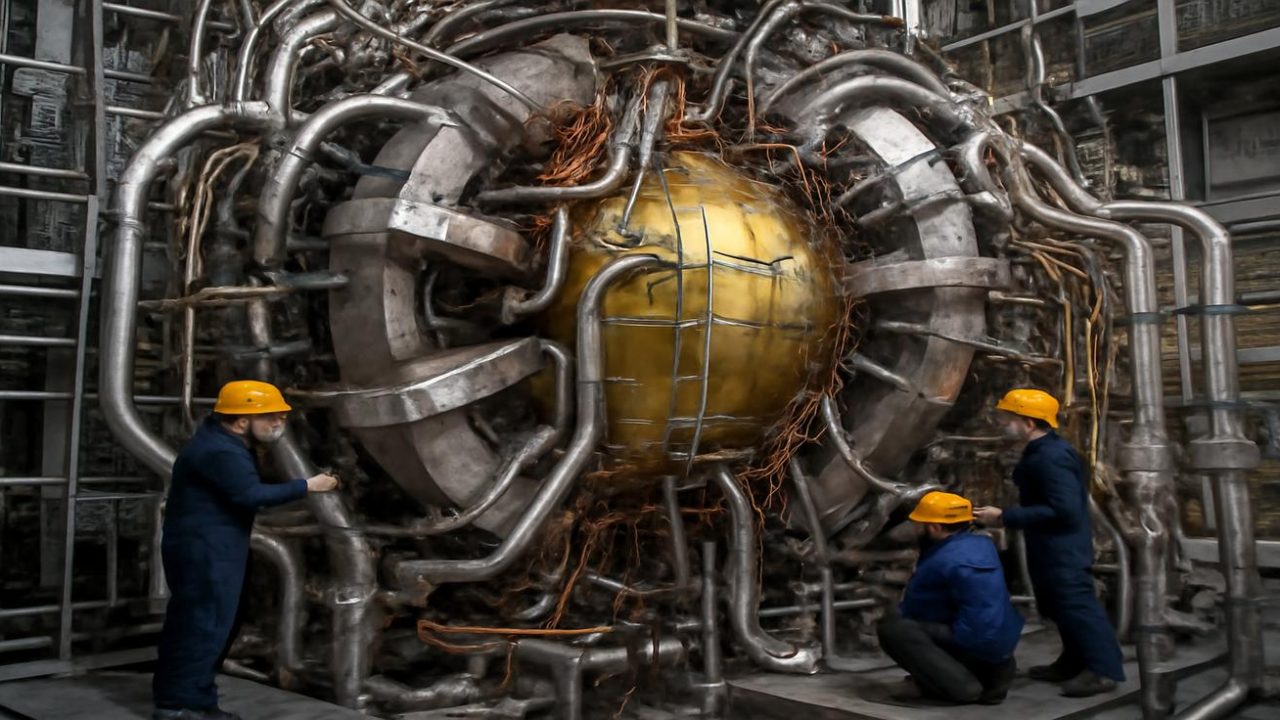
Deep in a cavernous hall in Oxfordshire, a latticed skeleton of metal curls around an invisible void where researchers hope to create a miniature sun burning hotter than anything on Earth. The United Kingdom’s newest fusion experiment represents a radical departure from traditional approaches to containing plasma—the fourth state of matter that could unlock virtually limitless clean energy.
Unlike conventional fusion machines that rely on simple magnetic cages, this device is designed to twist plasma in every direction imaginable, reconfiguring magnetic fields like a three-dimensional puzzle of pure energy.
The machine sits quietly in its hall, with only the soft whir of ventilation breaking the silence—a stark contrast to the stellar temperatures it aims to contain.

Why Traditional Fusion Machines Haven’t Solved the Energy Crisis
Fusion represents the oldest dream in modern energy science, yet it remains frustratingly elusive. The process that powers the Sun—fusing hydrogen atoms into helium—could provide clean, virtually limitless energy with no long-lived radioactive waste, no smokestacks, and no coal dust.
The fundamental challenge lies in containing plasma, matter so hot that electrons break free from atoms entirely. This superheated substance must be held away from material walls that would melt instantly upon contact.
For decades, researchers have relied on strong, precisely shaped magnetic fields to corral plasma. Traditional machines like tokamaks and stellarators have grown larger, stronger, and smarter over time. They’ve achieved record-breaking plasma shots lasting seconds, then longer periods.

But sustainable, power-plant-level fusion—the kind that runs as an everyday engine for civilization rather than a physics experiment—remains out of reach. The plasma writhes and squirms within its magnetic cage, developing instabilities that cause it to buckle and spill its contents.
The UK’s Revolutionary Approach to Plasma Control
The new British fusion device abandons the limitations of single magnetic architectures. Instead of simply scaling up old designs, researchers are building something fundamentally different: a platform capable of generating multiple magnetic field configurations.
Walk closer to the experiment’s heart and you see arcs and rings of polished steel interlocking like the ribs of a mechanical leviathan. Thick cables, cryogenic lines, and scaffolding form a dense web around the structure, which resembles an art installation devoted to geometry and magnetism more than a conventional power plant.

The machine features coils that can be re-energized in different sequences, creating magnetic fields that can be layered, twisted, and adjusted in real time. This flexibility allows researchers to counter plasma’s every move before instabilities spiral out of control.
Configurations can range from tokamak-like symmetry to asymmetric stellarator forms, plus hybrid shapes that barely have names yet. The device essentially serves as a machine for exploring every possible way plasma can be tamed.
How Magnetic Field Manipulation Could Change Everything
Plasma behaves unlike any familiar substance—it’s a fiercely collective state of matter that responds to magnetic forces in complex ways. Traditional tokamaks create a relatively simple doughnut-shaped magnetic cage, but this approach has inherent limitations.

The UK’s new machine addresses these constraints through unprecedented magnetic agility. Rather than committing to one single magnetic architecture, scientists can generate multiple field configurations and switch between them as needed.
This capability represents a fundamental shift in fusion research methodology. Instead of building larger versions of existing designs, researchers can now test entirely new approaches to plasma confinement within a single device.
The flexibility extends to real-time adjustments during plasma operations. As instabilities develop, the magnetic fields can be reshaped instantly to maintain control—like adjusting the shape of an invisible cage to keep lightning trapped in midair.

Key Technical Specifications and Capabilities
The British fusion device incorporates several advanced technologies that distinguish it from conventional machines:
- Reconfigurable magnetic coil systems that can generate multiple field geometries
- Real-time plasma control capabilities for instant field adjustments
- Hybrid magnetic configurations combining tokamak and stellarator features
- Advanced cryogenic systems to maintain superconducting coil operations
- Comprehensive diagnostic systems for monitoring plasma behavior
| Feature | Traditional Tokamak | UK Fusion Device |
|---|---|---|
| Magnetic Configuration | Fixed doughnut shape | Multiple reconfigurable geometries |
| Field Adjustment | Limited modifications | Real-time reshaping capability |
| Research Scope | Single confinement approach | Multiple plasma control methods |
| Operational Flexibility | Predetermined parameters | Adaptive response to plasma behavior |
The Broader Impact on Global Fusion Development
This experimental approach could accelerate fusion energy development by providing insights into plasma behavior that single-configuration machines cannot offer. Rather than building separate devices to test different magnetic field arrangements, researchers can explore multiple approaches within one facility.
The machine’s flexibility also allows for testing hybrid configurations that combine the best features of different magnetic confinement strategies. These novel approaches might reveal new pathways to stable, long-duration plasma operations.

For the global fusion community, the UK device represents a new research methodology that could inform future reactor designs. The ability to rapidly test and compare different magnetic configurations could identify the most promising approaches for commercial fusion power plants.
The quiet halls of Oxfordshire may soon echo with discoveries that reshape humanity’s energy future, as researchers learn to master the art of containing stellar fire within twisted magnetic fields.
What This Means for the Future of Clean Energy
Success with this experimental approach could bring fusion power significantly closer to commercial reality. By solving the fundamental challenge of plasma confinement through magnetic field manipulation, the technology could unlock the clean energy potential that fusion represents.

The implications extend far beyond the laboratory. Fusion power could provide clean electricity without the intermittency challenges of solar and wind power, using fuel derived from ordinary seawater.
However, significant engineering challenges remain even if plasma confinement is perfected. Converting experimental success into commercially viable power plants will require advances in materials science, reactor design, and energy extraction systems.
The UK’s innovative approach represents one piece of the fusion puzzle, but it addresses perhaps the most fundamental challenge: keeping plasma stable long enough to extract meaningful energy from the fusion process.

Frequently Asked Questions
What makes this UK fusion device different from other fusion experiments?
Unlike traditional machines with fixed magnetic field shapes, this device can reconfigure its magnetic fields in real time to test multiple plasma confinement approaches within a single machine.
How does the magnetic field manipulation work?
The device uses reconfigurable coils that can be re-energized in different sequences, allowing researchers to create various magnetic field geometries from simple doughnut shapes to complex hybrid configurations.
When will this lead to commercial fusion power?
The timeline for commercial fusion power has not been specified, as this device focuses on fundamental research into plasma confinement rather than power generation.
What fuel would fusion power plants use?
Fusion reactions would use hydrogen derived from ordinary seawater, providing a virtually limitless fuel source without the radioactive waste associated with nuclear fission.
Where exactly in the UK is this machine located?
The device is located in Oxfordshire, housed within a large experimental hall designed for fusion research.
How hot will the plasma become in this machine?
The plasma is designed to burn hotter than anything on Earth, though specific temperature targets have not been detailed in available information about the project.











Leave a Comment