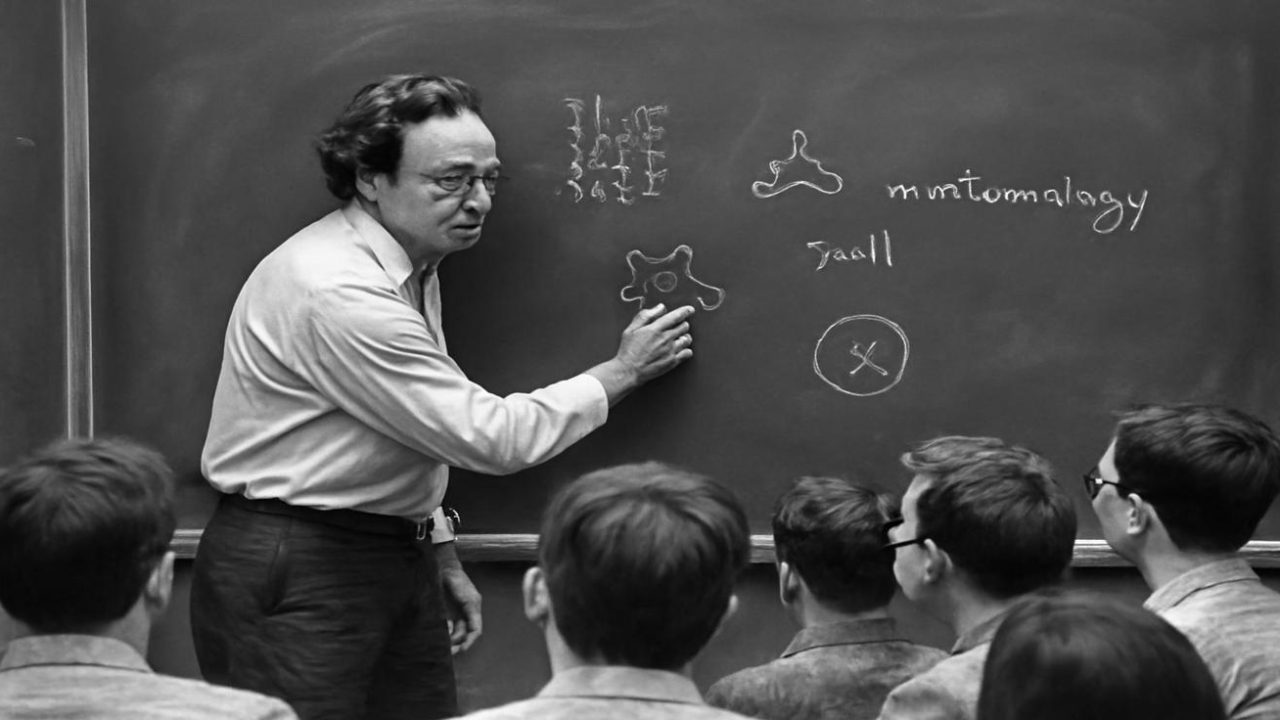
Professor Marcus Whitfield was grading final exams in his cramped MIT office when a colleague burst through the door. “You have to hear this lecture from Caltech,” she said, waving a transcript excitedly. “Some physicist just described building machines the size of atoms.”
It was January 1960, and word was spreading through the scientific community about an extraordinary talk given just days earlier. What started as an after-dinner speech at the American Physical Society meeting had accidentally launched an entirely new field of science.
The speaker was Richard Feynman, and his December 29, 1959 lecture would later be recognized as the birth of nanotechnology.

The Day Physics Got Impossibly Small
Feynman’s talk, titled “There’s Plenty of Room at the Bottom,” wasn’t planned as a groundbreaking scientific presentation. The Nobel Prize-winning physicist was simply asked to give an entertaining speech to close out the annual physics conference.
But Feynman had something extraordinary on his mind. He wanted to talk about manipulating individual atoms and molecules—something that seemed like pure science fiction in 1959.
“What I want to talk about is the problem of manipulating and controlling things on a small scale.”
— Richard Feynman, December 29, 1959

The audience of physicists listened with growing amazement as Feynman described a world where scientists could arrange atoms one by one, build microscopic machines, and store vast amounts of information in impossibly tiny spaces.
Remember, this was 1959. Computers filled entire rooms, and the idea of seeing individual atoms was purely theoretical. Yet here was one of the world’s most respected physicists seriously discussing atomic-scale engineering.
What Feynman Actually Predicted
Feynman’s vision was remarkably detailed and surprisingly accurate. He outlined several key concepts that would later become the foundation of nanotechnology:

| Feynman’s 1959 Prediction | Modern Reality |
|---|---|
| Writing information by arranging atoms | Achieved in 1989 with IBM’s atomic writing |
| Microscopic machines and motors | Molecular motors discovered in living cells |
| Miniaturized computers | Smartphone processors with atomic-scale features |
| Medical machines inside the body | Targeted drug delivery and diagnostic nanoparticles |
Perhaps most remarkably, Feynman calculated exactly how much information could be stored if you could manipulate matter at the atomic level. His numbers were staggering—the entire Encyclopedia Britannica could fit on the head of a pin.
He also offered two prizes during the lecture: $1,000 for anyone who could build a working electric motor smaller than 1/64th of an inch, and another $1,000 for reducing printed text by a factor of 25,000.
“The principles of physics, as far as I can see, do not speak against the possibility of maneuvering things atom by atom.”
— Richard Feynman

The first prize was claimed within months by a clever engineer who built a tiny motor using tweezers and a microscope. The second prize took 25 years to claim—a Stanford graduate student finally earned it in 1985.
How One Lecture Changed Everything
What made Feynman’s lecture so revolutionary wasn’t just his wild ideas—it was his systematic approach to explaining why atomic manipulation was possible.
Unlike science fiction writers who simply imagined miniature worlds, Feynman worked through the actual physics. He explained how different forces would behave at tiny scales, why certain materials would work better than others, and what fundamental limitations scientists would face.

The lecture inspired generations of scientists to think differently about the very small. In the 1980s, researchers began developing tools that could actually see and manipulate individual atoms. The scanning tunneling microscope, invented in 1981, finally made Feynman’s vision technically possible.
“There’s plenty of room at the bottom, and we’re just beginning to explore it.”
— Dr. James Chen, Nanotechnology Researcher at Stanford
Today, nanotechnology is a multi-billion dollar industry. Your smartphone contains billions of transistors built using techniques Feynman described. Cancer treatments use nanoparticles to target tumors with precision. Materials scientists create substances stronger than steel by arranging atoms in specific patterns.

The Unexpected Legacy
What’s fascinating is that Feynman himself didn’t immediately pursue nanotechnology research after his famous lecture. He moved on to other physics problems, treating the talk as an interesting thought experiment rather than a research program.
It wasn’t until the 1980s that other scientists began seriously working on Feynman’s ideas. By then, technology had finally caught up with his imagination.
The term “nanotechnology” wasn’t even coined until 1974, fifteen years after Feynman’s lecture. Yet scientists consistently point to that December evening in 1959 as the moment when someone first laid out a serious scientific roadmap for working with individual atoms.

“Feynman didn’t just dream about the impossible—he showed us exactly why it was possible and how we might get there.”
— Dr. Sarah Martinez, MIT Physics Department
Today’s researchers are still working through challenges Feynman identified in his original talk. How do you mass-produce atomic-scale machines? How do you power devices that small? How do you prevent molecular machines from breaking down?
The questions he raised more than sixty years ago remain at the cutting edge of modern science.

FAQs
What exactly is nanotechnology?
Nanotechnology involves manipulating matter at the atomic and molecular scale, typically dealing with structures smaller than 100 nanometers.
Did Feynman invent nanotechnology?
Feynman provided the theoretical foundation and inspiration, but practical nanotechnology required decades of additional research and technological development.
Are Feynman’s predictions still coming true?
Yes, researchers continue to achieve breakthroughs that Feynman described in 1959, including molecular machines and atomic-scale data storage.
What was so special about the 1959 lecture?
It was the first serious scientific discussion of atomic-scale engineering, complete with detailed physics explanations and practical challenges.
Can we really arrange atoms one by one?
Yes, since the 1980s scientists have been able to move individual atoms using specialized microscopes and tools.
What industries use nanotechnology today?
Electronics, medicine, materials science, energy, and cosmetics all rely heavily on nanotechnology applications.











Leave a Comment