Dr. Elena Vasquez had been staring at the same data screen for three hours when her colleague burst into the lab at Johns Hopkins. “Elena, you need to see this,” he said, breathless with excitement. “The Parker probe just sent back readings that… well, they’re going to change everything we thought we knew about the Sun.”
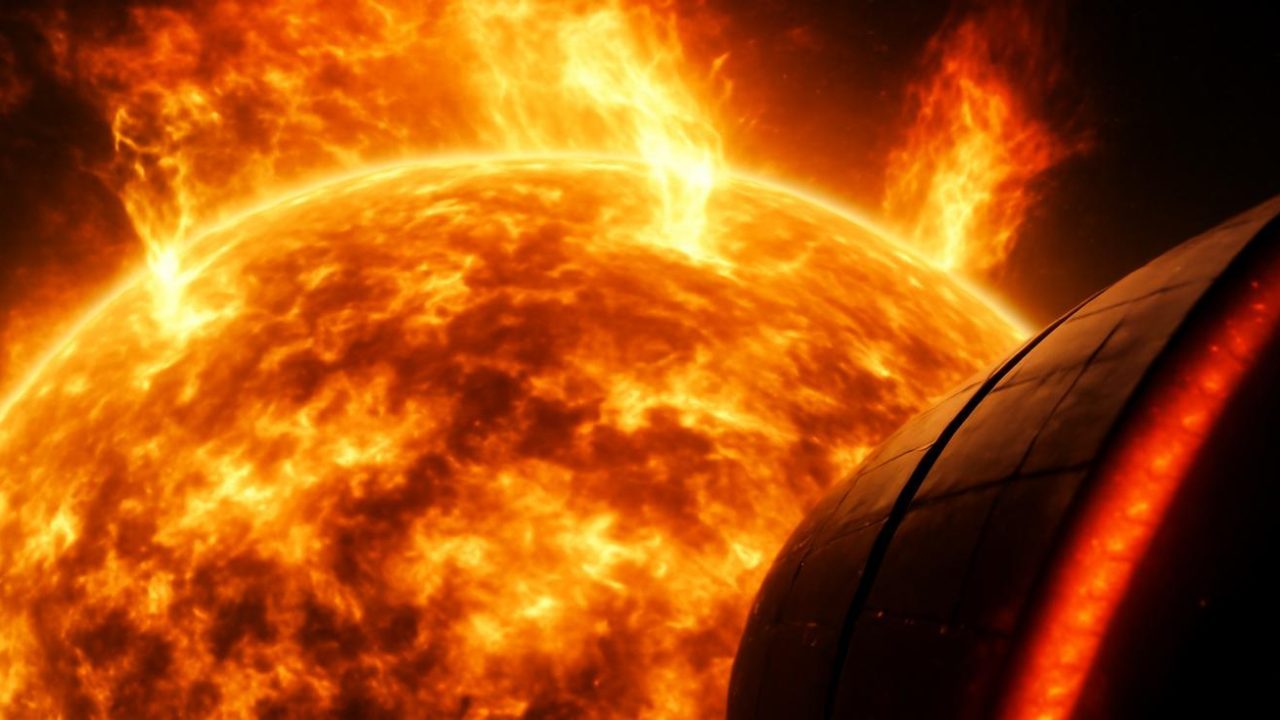
That moment in December 2024 marked a turning point in solar science. NASA’s Parker Solar Probe had just completed the closest flyby of the Sun in human history, diving within 3.8 million miles of our star’s surface. To put that in perspective, if Earth were the size of a football field, this spacecraft got within arm’s reach of a blazing campfire.
What the probe discovered during that death-defying plunge is now forcing scientists to rewrite textbooks and question theories that have stood for over a century.

Breaking Through the Sun’s Mysteries
The Parker Solar Probe didn’t just get close to the Sun—it survived temperatures exceeding 2,500 degrees Fahrenheit while traveling at speeds of 430,000 miles per hour. That’s fast enough to fly from New York to Los Angeles in 20 seconds.
But speed records weren’t the goal. Scientists launched this mission to solve one of astronomy’s most perplexing puzzles: why is the Sun’s outer atmosphere, called the corona, hundreds of times hotter than its surface?
Imagine a campfire where the flames are somehow cooler than the air around them. That’s essentially what we’ve been seeing with the Sun for decades, and it defies basic physics.

“It’s like discovering that the air above a hot stove is somehow 300 times hotter than the stove itself. It shouldn’t happen, but it does, and we’ve been scratching our heads about it since the 1940s.”
— Dr. Nour Raouafi, Parker Solar Probe Project Scientist
The probe’s latest data is revealing that magnetic field lines in the corona are far more twisted and dynamic than anyone imagined. These invisible forces are creating a cosmic dance that generates enormous amounts of energy.
What the Probe Found in the Sun’s Furnace
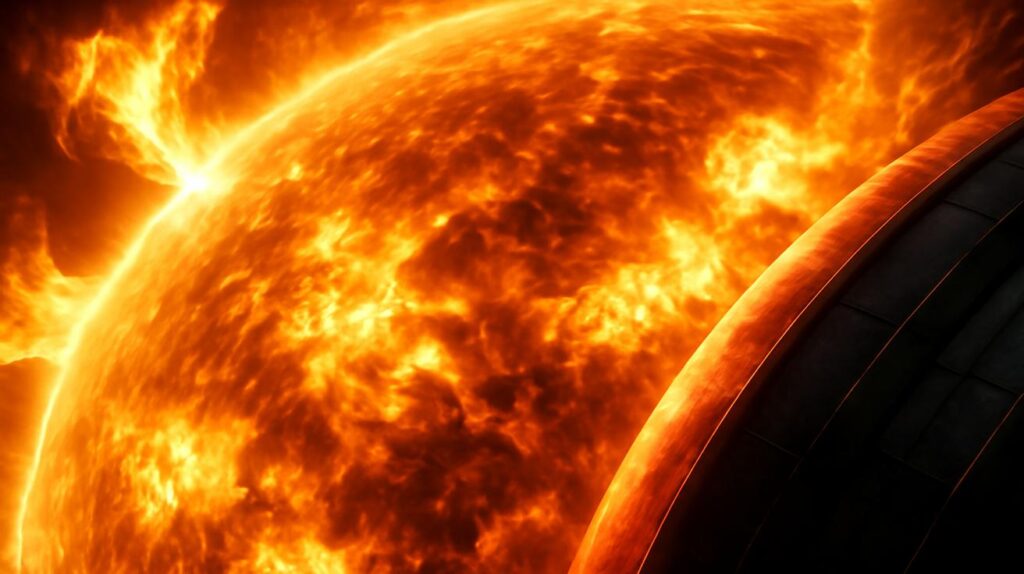
The Parker Solar Probe’s instruments captured phenomena that ground-based telescopes could never detect. Here’s what scientists discovered during this historic close encounter:

| Discovery | Previous Theory | New Understanding |
|---|---|---|
| Magnetic Field Behavior | Relatively stable and predictable | Extremely dynamic with rapid reversals |
| Solar Wind Origin | Gradual acceleration from corona | Sudden bursts from magnetic reconnection |
| Coronal Temperature Source | Unknown heating mechanism | Magnetic field energy release |
| Plasma Wave Activity | Smooth energy transfer | Turbulent, chaotic interactions |
- Switchback phenomena: The probe detected massive reversals in the Sun’s magnetic field that happen in seconds, not the hours scientists expected
- Coronal holes: These regions are shooting solar wind at Earth much faster than predicted, potentially affecting our satellites and power grids
- Plasma waves: The spacecraft recorded sound-like vibrations that are literally shaking the corona and heating it to extreme temperatures
- Dust-free zones: Areas near the Sun are surprisingly clean, suggesting the star’s heat vaporizes space debris more efficiently than thought
“We’re seeing the Sun’s magnetic field doing things we never imagined. It’s like watching a cosmic symphony where every instrument is playing a different tune, but somehow it all creates this beautiful, terrifying harmony.”
— Dr. Stuart Bale, University of California Berkeley
Why This Changes Everything for Life on Earth
These discoveries aren’t just academic curiosities. Understanding how the Sun works directly affects life on our planet in ways most people never consider.
Solar storms—massive eruptions of charged particles from the Sun—can knock out power grids, disable satellites, and even ground airline flights. The 1989 Quebec blackout that left millions without power for nine hours? That was caused by a solar storm much smaller than what the Sun is capable of producing.

With the Parker probe’s new data, scientists can now better predict when these cosmic tantrums might occur. The spacecraft’s findings suggest that magnetic field reversals in the corona serve as early warning signs for major solar eruptions.
“Think of it like finally understanding the warning signs before a volcano erupts. We’re not just watching the Sun anymore—we’re learning to read its moods.”
— Dr. Nicholeen Viall, NASA Goddard Space Flight Center
The implications extend beyond Earth’s immediate safety. As we plan missions to Mars and establish permanent bases on the Moon, understanding solar radiation becomes critical for astronaut safety. The probe’s data will help engineers design better shielding for spacecraft and habitats.

Climate scientists are also paying attention. While the Sun’s energy output remains relatively stable, tiny variations can influence Earth’s weather patterns over long periods. The probe’s measurements are providing the most accurate data ever collected about these subtle changes.
Perhaps most importantly, this mission is teaching us about stars in general. Every star in the universe operates on similar principles to our Sun. By understanding how stellar coronas work, we’re gaining insights into planetary systems throughout the galaxy.
“The Parker probe isn’t just studying our Sun—it’s giving us a masterclass in how stars work everywhere in the universe. That knowledge will be invaluable as we search for other habitable worlds.”
— Dr. Adam Szabo, NASA Mission Scientist

The spacecraft still has several more close approaches planned through 2025, with each pass bringing it even closer to the Sun’s surface. Scientists expect these final encounters to reveal even more secrets about our nearest star.
What started as a bold engineering challenge—building a spacecraft that could survive the Sun’s hellish environment—has become one of the most important scientific missions of our time. The century-old mystery of coronal heating is finally being solved, and the answers are more fascinating than anyone imagined.
FAQs
How close did the Parker Solar Probe get to the Sun?
The probe flew within 3.8 million miles of the Sun’s surface, closer than any human-made object in history.

How does the spacecraft survive such extreme heat?
It uses a special heat shield made of carbon composite materials that can withstand temperatures over 2,500°F while keeping instruments cool.
What is the coronal heating problem?
Scientists have puzzled for decades over why the Sun’s outer atmosphere is hundreds of times hotter than its surface, which defies normal physics.
How fast is the Parker Solar Probe traveling?
At its closest approach, the probe reaches speeds of 430,000 miles per hour, making it the fastest human-made object ever.

When will we get more data from the mission?
The probe will continue making close approaches through 2025, with each pass potentially revealing new discoveries about our Sun.
How might this affect space weather predictions?
The new understanding of magnetic field behavior could help scientists better predict dangerous solar storms that threaten satellites and power grids on Earth.











Leave a Comment