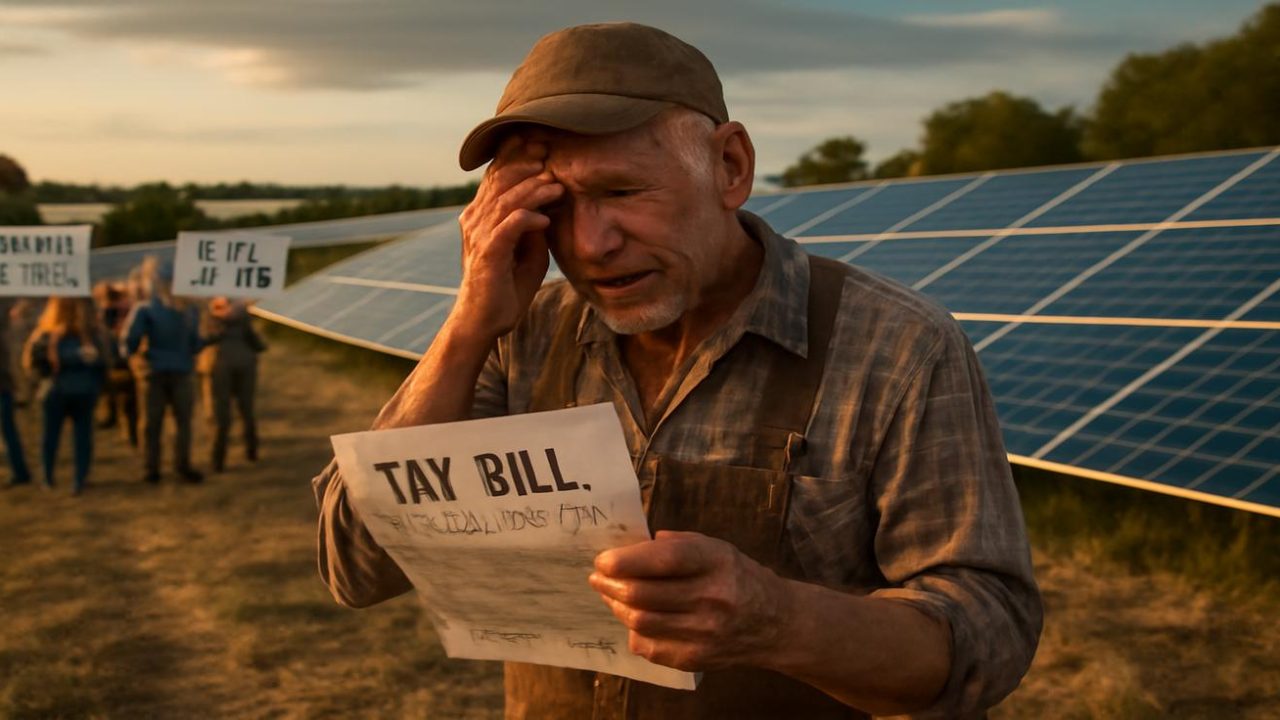
A retired farmer’s decision to lease unused land for solar panels has resulted in a property tax bill nearly three times higher than the previous year, sparking a heated debate about renewable energy incentives and their unintended consequences. The case highlights a growing dilemma facing rural landowners who embrace green energy only to discover crushing financial penalties hidden in the fine print of local tax assessments.
Harold Turner, 72, received the shocking tax notice on what seemed like an ordinary Tuesday morning. The bill represented the kind of financial blow that threatened to derail his carefully planned retirement, all because he had tried to make productive use of farmland that was no longer economically viable for traditional agriculture.
The situation illustrates a fundamental tension in America’s push toward renewable energy: while federal and state governments encourage solar development, local tax policies often punish landowners who participate in these programs.

How Solar Panels Triggered a Tax Assessment Nightmare
Turner’s story begins with a common rural reality. His 180-acre property, inherited through three generations of his family, had become increasingly difficult to farm profitably. Rising costs and volatile crop prices had made traditional agriculture a losing proposition for many small operators in the Midwest.
When a solar company approached Turner about leasing portions of his unused land, it seemed like the perfect solution. The arrangement would generate steady income while contributing to renewable energy goals. The land that once grew corn would now harvest sunlight instead.
What Turner didn’t anticipate was how local tax assessors would view the solar installation. The panels dramatically increased his property’s assessed value, triggering a tax bill that wiped out much of the financial benefit he expected from the solar lease.

The assessment treated the solar infrastructure as a permanent improvement to the property, similar to how a new building or other development would be valued. This approach fails to account for the temporary nature of most solar leases and the fact that landowners typically don’t own the panels themselves.
The Hidden Costs of Going Green
Turner’s experience reveals several critical issues with current tax policy around renewable energy development:
- Property tax assessments often increase dramatically when solar panels are installed, even if the landowner doesn’t own the equipment
- Many landowners are unaware of potential tax implications before signing solar lease agreements
- Local tax assessors may lack clear guidelines for valuing solar installations on agricultural land
- The tax burden can exceed the income generated by solar leases, creating a net financial loss
The situation is particularly problematic for retired farmers and others on fixed incomes. These property owners may have viewed solar leasing as a way to generate modest retirement income from land they could no longer farm effectively.

Instead, they find themselves facing tax bills that can consume their entire lease payment and more. The financial stress can force difficult decisions about whether to maintain ownership of family land that has been passed down through generations.
Why This Case Divides Public Opinion
Turner’s predicament has generated sharply divided reactions from different segments of the community. The split reflects broader tensions about renewable energy development, property rights, and tax policy.
Supporters of renewable energy argue that solar development represents economic progress and environmental responsibility. They contend that increased property values reflect the genuine improvement solar installations bring to rural areas. From this perspective, higher tax assessments are simply the natural consequence of property enhancement.

Critics, however, see the situation as a betrayal of landowners who responded to calls for green energy adoption. They argue that punishing property owners for participating in renewable energy programs undermines stated policy goals and creates perverse incentives.
| Perspective | Key Arguments | Proposed Solutions |
|---|---|---|
| Pro-Assessment | Solar panels increase property value; taxes should reflect actual worth | Maintain current assessment practices |
| Pro-Landowner | Excessive taxation discourages renewable energy participation | Create agricultural exemptions for solar leases |
| Local Government | Need tax revenue for public services | Seek alternative revenue sources |
The debate also touches on fundamental questions about rural economic development. Some view solar installations as a lifeline for struggling agricultural communities, while others worry about the transformation of traditional farming landscapes.
The Broader Impact on Rural Communities
Turner’s case represents a much larger trend affecting rural landowners across the country. As solar development expands into agricultural areas, similar tax assessment disputes are emerging in farming communities nationwide.
The situation creates uncertainty for both landowners considering solar leases and developers seeking to expand renewable energy capacity. Potential participants may hesitate to enter agreements if they cannot predict the full financial implications.
Rural communities also face difficult choices about how to balance their need for tax revenue with their desire to support renewable energy development. Local governments depend on property tax income to fund schools, roads, and other essential services.
The controversy highlights gaps in policy coordination between different levels of government. While federal and state authorities promote renewable energy through various incentives, local tax policies may inadvertently undermine these efforts.

What Happens Next
Turner’s situation remains unresolved, leaving him to navigate the complex appeals process for property tax assessments. The outcome could set important precedents for how similar cases are handled in the future.
Several potential solutions have been proposed to address the underlying policy conflict. These include creating special tax classifications for agricultural land used for solar development, implementing phase-in periods for assessment increases, or providing exemptions for landowners who don’t own the solar equipment.
Some states are already reconsidering their approach to solar taxation in response to similar controversies. Policy makers are beginning to recognize that poorly designed tax policies can undermine renewable energy goals and create unfair burdens for rural landowners.

The resolution of cases like Turner’s may ultimately require coordination between local assessors, state tax authorities, and renewable energy advocates to develop more equitable approaches to valuing solar installations on agricultural property.
Frequently Asked Questions
Why did Harold Turner’s property taxes increase so dramatically?
Local tax assessors treated the solar panels as a permanent improvement to his property, increasing the assessed value and resulting in a tax bill nearly three times higher than the previous year.
Does the landowner own the solar panels in most lease agreements?
No, in typical solar lease arrangements, the solar company owns the panels and equipment while paying the landowner for use of the land.

Are there any protections for farmers who lease land for solar development?
Current protections vary by state and locality, with many areas lacking clear policies to address the tax implications of solar leasing on agricultural land.
How common is this type of tax assessment problem?
Similar cases are emerging in rural communities across the country as solar development expands into agricultural areas, though specific details have not been widely documented.
What can landowners do if they face unexpected tax increases from solar installations?
Landowners can typically appeal their property tax assessments through local procedures, though the success of such appeals depends on local policies and precedents.
Are there any proposed solutions to prevent this problem?
Proposed solutions include creating special tax classifications for agricultural solar land, implementing assessment phase-in periods, and providing exemptions for landowners who don’t own the solar equipment.









Leave a Comment