Long before the first factory smokestacks darkened the sky, ancient humans were already reshaping Earth’s ecosystems in ways that would surprise modern environmentalists. New archaeological evidence reveals that our ancestors left a far more significant ecological footprint than scientists previously understood, fundamentally altering forests, wildlife populations, and entire landscapes thousands of years before the industrial age.
The comfortable narrative that early humans lived in harmony with nature as “respectful wanderers” is crumbling under mounting scientific evidence. As researchers analyze ancient sediments, pollen samples, bones, and DNA, they’re discovering that human impact on the environment began much earlier and was far more extensive than anyone imagined.
This revelation is forcing scientists to completely rethink humanity’s relationship with the natural world and challenges our assumptions about when environmental destruction truly began.

Ancient Humans Were Environmental Engineers, Not Passive Observers
The evidence is buried in layers of soil across multiple continents, telling the same story again and again. In the Amazon rainforest, researchers are finding charcoal deposits and sudden shifts in pollen records that point to deliberate human intervention in natural systems.
What scientists once considered pristine wilderness untouched by human hands is revealing a different truth. The Amazon, long thought to be a vast green expanse operating under purely natural rules before European contact, shows clear archaeological evidence of ancient earthworks and modified soils.
Similar patterns emerge across Australia, Africa, and North America. The “wild” forests that seem untouched by modern technology often bear the invisible signatures of human management stretching back millennia.

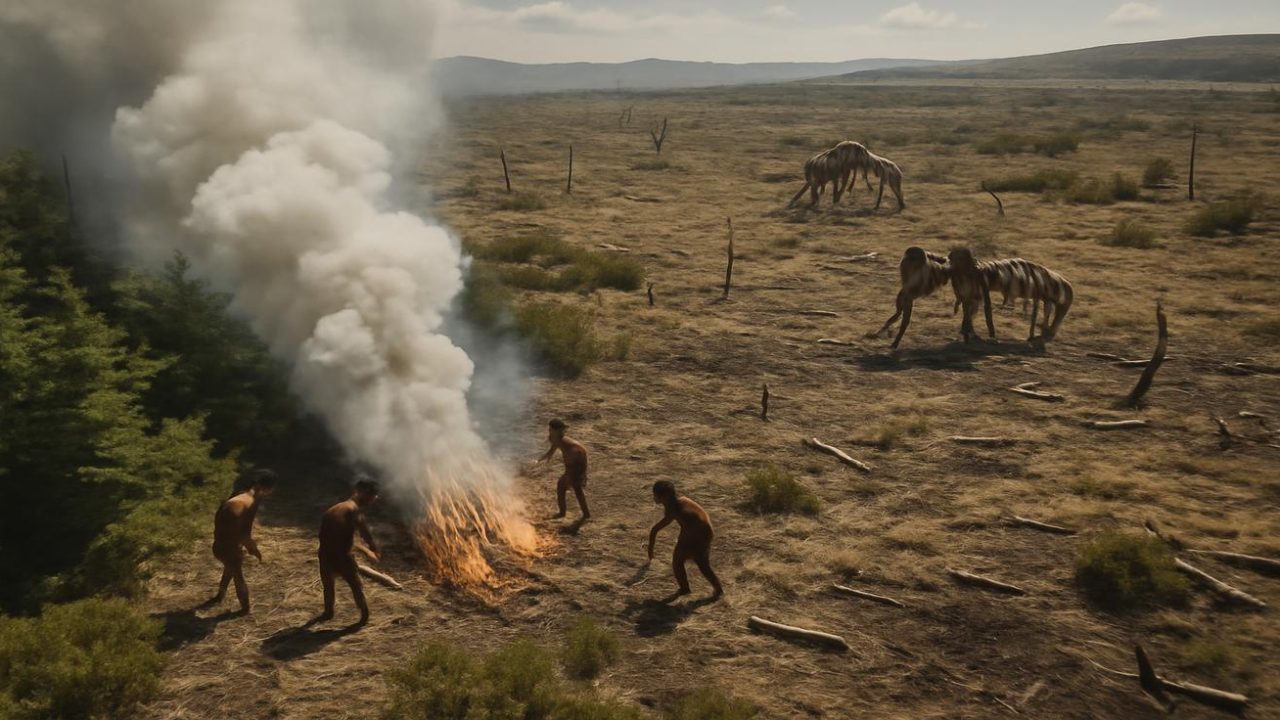
Fire appears to have been humanity’s primary tool for landscape modification. Ancient peoples used controlled burns to manage vegetation, create hunting grounds, and encourage the growth of useful plants. These practices left behind distinctive charcoal layers that archaeologists can now read like pages in a history book.
The Forest That Remembered Human Fire
Imagine walking through what appears to be virgin forest—towering trees draped in moss and lichen, thick understory vegetation, and the rich smell of decomposing organic matter. This seemingly untouched ecosystem may actually be the product of thousands of years of human management through strategic burning.
Researchers are discovering that many forests across different continents bear the hidden marks of ancient human activity. The very composition of tree species, the distribution of plants, and the structure of these ecosystems reflect decisions made by people who lived centuries or millennia ago.

These findings challenge the fundamental distinction between “natural” and “human-modified” environments. If human influence extends back so far and so deeply, scientists must reconsider what constitutes a baseline for ecosystem health and conservation efforts.
| Region | Evidence of Ancient Human Impact | Primary Methods Used |
|---|---|---|
| Amazon Rainforest | Ancient earthworks, modified soils | Controlled burning, soil management |
| Australia | Charcoal layers, vegetation shifts | Fire management, selective burning |
| North America | Pollen changes, charcoal deposits | Landscape burning, species management |
| Africa | Soil signatures, ecosystem changes | Fire use, wildlife management |
Why This Discovery Matters for Modern Conservation
Understanding the true extent of ancient human environmental impact has profound implications for how we approach conservation and ecosystem management today. If humans have been actively shaping landscapes for thousands of years, the concept of returning ecosystems to a “natural” state becomes much more complicated.
Many ecosystems that conservationists work to protect may actually depend on human management practices that indigenous peoples developed over centuries. Removing human influence entirely might not restore these systems to health—it could actually harm them.

This research also provides crucial context for current environmental challenges. While ancient human impact was significant, it operated on much longer timescales and used different methods than modern industrial activities. The speed and scale of contemporary environmental change remains unprecedented.
For land managers and conservationists, these findings suggest that traditional indigenous knowledge about ecosystem management may be essential for effective conservation strategies. Practices that sustained landscapes for thousands of years could offer valuable insights for modern environmental stewardship.
Rewriting the Story of Human Environmental Impact
The emerging picture of ancient human environmental influence is forcing scientists to abandon simple narratives about humanity’s relationship with nature. Rather than a clear division between a pristine past and a destructive present, the reality appears to be far more complex.

Ancient humans were neither passive inhabitants of natural systems nor destructive forces comparable to modern industrial society. Instead, they were active ecosystem managers who developed sophisticated techniques for modifying their environments to meet their needs while maintaining long-term sustainability.
This doesn’t diminish the severity of contemporary environmental challenges, but it does provide a more nuanced understanding of how human societies can interact with natural systems. The key difference lies not in whether humans modify their environment, but in how they do so and at what scale.
The archaeological evidence suggests that successful long-term human habitation requires active ecosystem management rather than minimal intervention. This insight could prove crucial as modern societies grapple with finding sustainable ways to live within planetary boundaries.

What Scientists Are Learning from Ancient Sediments
The techniques archaeologists and ecologists use to uncover this ancient environmental history are remarkably sophisticated. By analyzing layers of sediment, researchers can reconstruct detailed pictures of past ecosystems and human activities.
Charcoal particles preserved in soil reveal the timing and intensity of fires, while pollen grains show which plant species dominated different time periods. Changes in these patterns often coincide with archaeological evidence of human settlement, suggesting deliberate landscape management.
Ancient DNA extracted from sediments can even reveal which animal species were present in different eras, showing how human activities influenced wildlife populations over time. This biological archive provides unprecedented insights into how ecosystems responded to human management practices.

The convergence of evidence from multiple continents suggests that landscape modification through fire and other techniques was a nearly universal human adaptation. This points to fundamental patterns in how our species has always interacted with the natural world.
Frequently Asked Questions
How long ago did humans start significantly impacting their environments?
Archaeological evidence suggests humans have been actively modifying landscapes for thousands of years, long before the industrial revolution, though the exact timeframes vary by region.
What methods did ancient peoples use to change their environments?
Fire management was the primary tool, along with selective harvesting, soil modification, and strategic wildlife management practices.

Does this mean modern environmental problems aren’t as serious?
No—while ancient human impact was significant, modern industrial activities operate at unprecedented speeds and scales that create fundamentally different challenges.
How are scientists discovering this ancient environmental impact?
Researchers analyze charcoal layers, pollen samples, ancient DNA, and archaeological evidence preserved in sediment layers to reconstruct past ecosystems and human activities.
What does this mean for current conservation efforts?
It suggests that some ecosystems may require active human management rather than minimal intervention, and that indigenous knowledge could be crucial for effective conservation strategies.
Were ancient humans better environmental stewards than modern people?
Ancient peoples developed sustainable practices over long time periods, but they also operated at much smaller population scales with different technologies than modern societies face today.










Leave a Comment