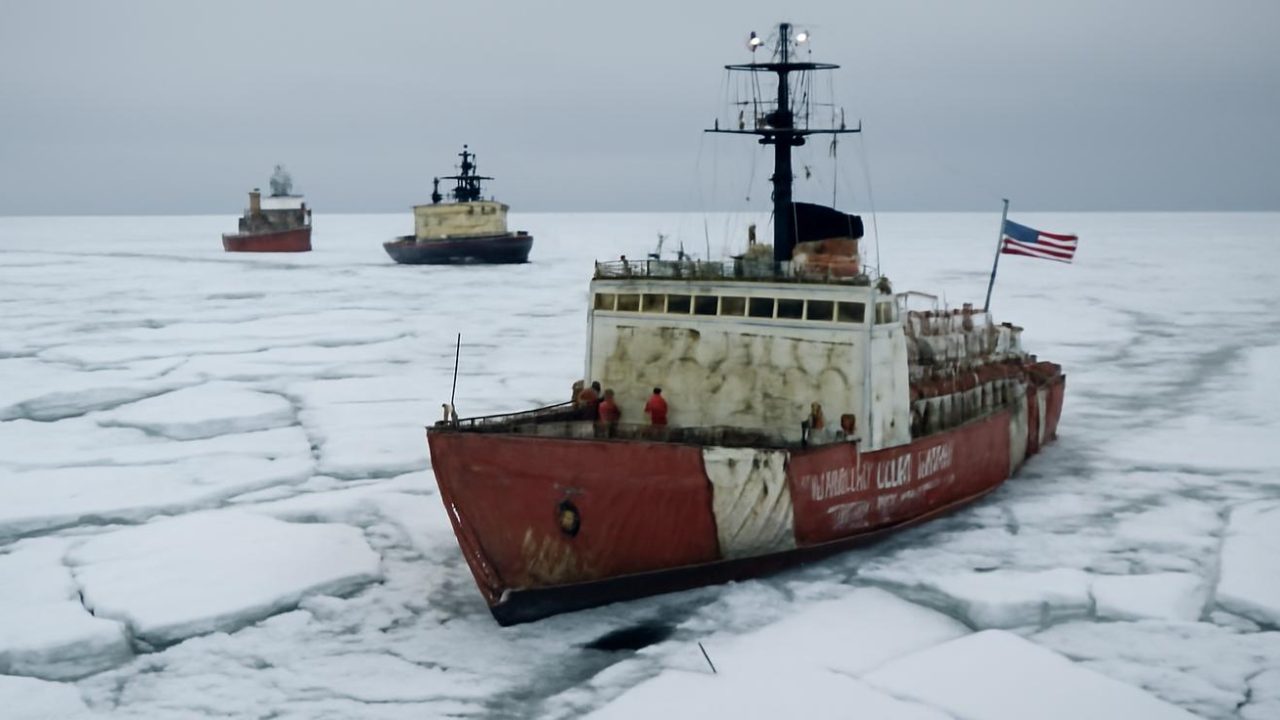
The United States operates just one heavy icebreaker capable of breaking through thick Antarctic ice — a 399-foot vessel commissioned in 1976 that suffers regular mechanical failures and leaves crews wondering if it will survive each mission.
While other nations have expanded their polar capabilities, America’s icebreaker fleet has deteriorated to the point where the country now seeks assistance from allies with stronger maritime programs. The situation highlights a strategic vulnerability that has grown more pressing as Arctic and Antarctic regions become increasingly important for research, supply missions, and geopolitical positioning.
The aging Polar Star represents both the extent of America’s current capabilities and the precarious state of its polar operations, struggling through missions with makeshift repairs and constant mechanical problems.

America’s Lone Heavy Icebreaker Fights to Stay Afloat
The Polar Star serves as the United States’ only heavy icebreaker still capable of punching through thick Antarctic sea ice to resupply McMurdo Station. Commissioned in 1976, the vessel predates modern technology by decades — built when rotary phones were still common in American homes and Arctic regions weren’t yet considered geopolitical flashpoints.
The ship’s age shows in every aspect of its operation. Inside the hull, pipes rattle constantly, paint flakes from surfaces, and engineers work around the clock to keep aging engines running. The mechanical problems aren’t minor inconveniences — they’re mission-threatening failures that occur regularly during critical operations.
Recent deployments have seen the Polar Star suffer flooded compartments, fires in the engine room, and electrical failures that compromise essential systems. During one Antarctic mission, crew members had to perform emergency welding repairs in the middle of their deployment, highlighting how precarious these operations have become.

As one crew member noted in a previous interview, “Every time we go south, we wonder if she’ll make it back.” This wasn’t said in jest — it reflects the genuine uncertainty surrounding each mission undertaken by America’s aging icebreaker fleet.
The Mechanics of Ice-Breaking Reveal Strategic Importance
Understanding why icebreakers matter requires seeing how they operate in polar conditions. These vessels don’t simply push through ice like traditional ships moving through water. Instead, they employ a deliberate and violent process that seems to defy normal maritime physics.
The bow of an icebreaker climbs onto thick slabs of sea ice, creating an improbable scene where thousands of tons of steel rest precariously on frozen surfaces. Then gravity takes control — the ship crashes down with tremendous force, causing ice to groan, fracture, and spread into spiderweb patterns of cracks before the vessel lurches forward to repeat the process.

This capability isn’t just impressive to watch — it’s strategically essential. Without functional icebreakers, nations cannot maintain year-round access to polar research stations, conduct scientific missions in ice-covered waters, or project power in regions where ice coverage determines accessibility.
Key Challenges Facing America’s Icebreaker Program
The problems with America’s icebreaker capabilities extend beyond the Polar Star’s mechanical issues. The broader fleet situation reveals systematic underinvestment in polar maritime capabilities over several decades.
- Fleet Size: The U.S. operates significantly fewer icebreakers than other nations with polar interests
- Age of Vessels: Existing ships are decades old, with the Polar Star representing nearly 50 years of service
- Maintenance Costs: Keeping aging vessels operational requires increasingly expensive and frequent repairs
- Limited Redundancy: With only one heavy icebreaker, any major breakdown could halt critical Antarctic operations
- Technological Gaps: Modern icebreaking technology has advanced significantly since the 1970s
The situation has reached a point where the United States must seek assistance from allied nations that have maintained stronger icebreaker programs. This represents a significant shift from historical American maritime dominance in polar regions.

| Vessel Component | Current Status | Impact on Operations |
|---|---|---|
| Engine Systems | Frequent failures requiring repairs | Mission delays and emergency maintenance |
| Hull Integrity | Regular flooding in compartments | Safety risks and operational limitations |
| Electrical Systems | Recurring power failures | Communication and navigation disruptions |
| Overall Reliability | Uncertain mission completion | Crew concerns about vessel survival |
Why This Matters Beyond Antarctica
The implications of America’s icebreaker shortage extend far beyond Antarctic research missions. As climate change alters ice coverage patterns and geopolitical tensions increase in polar regions, nations with strong icebreaking capabilities gain significant advantages.
Research operations depend entirely on reliable access to polar regions. McMurdo Station and other scientific facilities require regular resupply missions that only heavy icebreakers can accomplish during certain seasons. Without dependable vessels, these research programs face potential disruption or abandonment.
The strategic dimensions are equally important. Nations that can operate effectively in ice-covered waters maintain access to shipping routes, resource exploration opportunities, and territorial claims that others cannot reach or defend. America’s reliance on aging, unreliable vessels puts these interests at risk.

Economic factors also come into play. As Arctic shipping routes become more viable due to changing ice conditions, countries with modern icebreaker fleets will be better positioned to take advantage of new commercial opportunities and shorter transportation routes between major markets.
The Path Forward Requires International Cooperation
Recognizing the severity of its icebreaker deficit, the United States has begun seeking assistance from allied nations with stronger polar capabilities. This approach acknowledges that rebuilding America’s icebreaker fleet will take years, while current operational needs cannot wait for new construction.
The two Western nations being approached for assistance have invested consistently in their icebreaker programs over decades, maintaining modern fleets capable of handling the most challenging polar conditions. Their expertise and vessels could provide interim solutions while America works to rebuild its own capabilities.

However, relying on foreign assistance for access to polar regions represents a significant shift in American maritime strategy. Historically, the United States maintained independent capabilities for critical operations, particularly in strategically important areas like Antarctica.
The situation also highlights broader questions about infrastructure investment and strategic planning. The deterioration of America’s icebreaker fleet didn’t happen overnight — it resulted from decades of deferred maintenance, delayed replacements, and insufficient investment in polar capabilities.
Frequently Asked Questions
How many heavy icebreakers does the United States currently operate?
The United States operates just one heavy icebreaker, the Polar Star, which was commissioned in 1976.
What specific problems has the Polar Star experienced recently?
The vessel has suffered flooded compartments, engine room fires, electrical failures, and mechanical problems requiring emergency welding repairs during missions.
Why are icebreakers important for Antarctic operations?
Heavy icebreakers are the only vessels capable of breaking through thick Antarctic sea ice to resupply research stations like McMurdo Station during certain seasons.
Which countries is the United States asking for help?
The United States is seeking assistance from two Western nations that have maintained stronger icebreaker programs, though specific countries are not detailed in available information.

How do icebreakers actually break through ice?
Icebreakers climb onto ice slabs with their bow, then use gravity to crash down with tremendous force, fracturing the ice into spiderweb patterns before moving forward to repeat the process.
What happens if the Polar Star suffers a major breakdown?
With only one heavy icebreaker, any major failure could halt critical Antarctic resupply operations and leave research stations without essential support.











Leave a Comment